You’ve validated the idea. Maybe you’ve raised pre-seed funding, or you’re bootstrapping with conviction. Now comes the decision that shapes everything that follows: who should be your first technical hire?
If you can’t afford (or don’t need) a full-time CTO, and you’re not ready to outsource to an agency, the answer is usually a founding engineer. But the title is used loosely, and hiring the wrong person for the wrong reasons is one of the most expensive early mistakes founders make.
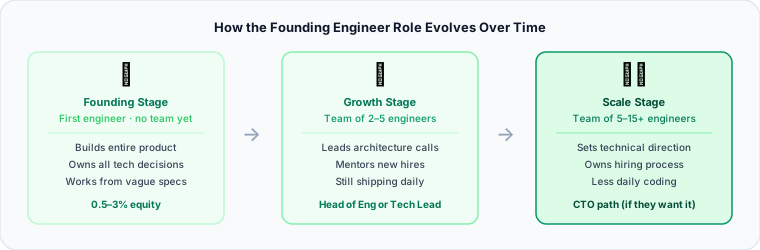
What is a Founding Engineer?
A founding engineer is typically the first or one of the first engineering hires at a startup. They’re not just a developer. They’re someone who takes full technical ownership of building the product, often with significant autonomy and equity upside.
It reflects a specific archetype: an engineer who wants the startup experience (ownership, equity, impact) without necessarily being a co-founder or CTO.
Founding Engineer vs. Senior Developer
A senior developer writes code and solves technical problems. A founding engineer does that and more: they make architectural decisions with long-term implications, own the entire technical stack rather than just their assigned features, interface directly with customers and stakeholders, help hire and onboard the engineers who come after them, and take on work that has no clear specification. The mindset is fundamentally different. A senior developer asks “what should I build?” A founding engineer asks “what should we build, and how do we make it work?”
Founding Engineer vs. CTO
There’s meaningful overlap, but key differences. For a full comparison, see our Founding Engineer vs CTO guide.
| Aspect | Founding Engineer | CTO |
|---|---|---|
| Primary focus | Building the product | Leading the technical org |
| Hands-on coding | Most of their time | Decreasing over time |
| Team management | Eventually, as team grows | From the start |
| Strategic planning | Involved, but secondary | Primary responsibility |
| Typical equity | 0.5-2% | 1-5% (or co-founder levels) |
| Experience level | 3-10 years | 10-20+ years |
A founding engineer often becomes a CTO as the company grows, but they don’t start with that title or full CTO responsibilities. They’re hired to build first, lead second.
What Does a Founding Engineer Do?
In the earliest days, their job is to ship. They take whatever exists: a Figma mockup, a requirements doc, or just conversations with you, and turn it into working software. That means choosing the tech stack, setting up infrastructure, writing most of the early code, and making pragmatic tradeoffs between speed and quality.
Unlike engineers at larger companies, they own everything: frontend, backend, database, deployment, and security. They don’t have the luxury of specialization. They make architectural decisions with long-term implications, and they do it fast, often without clear specifications.
The best founding engineers are unusually comfortable with ambiguity. They translate vague ideas into concrete implementations, propose solutions without being asked, and sit in on customer calls to understand why they’re building what they’re building. As the team grows, they shape what engineering looks like: setting coding standards, documenting decisions, and mentoring the engineers who join after them.
When Should You Hire a Founding Engineer?
The founding engineer role isn’t right for every startup at every stage.
You Have a Clear Product Vision
You don’t need full specifications, but you need a clear direction. If you’re still exploring whether to build product A, B, or C, it’s too early. If you know you’re building product A and need someone to figure out how, you’re ready.
You Have Some Validation
Most founding engineers want to join something with traction signals: customer interviews showing real demand, pre-orders or letters of intent, a landing page that’s converted, some form of funding, or at minimum a clear ability to fund their salary.
Pure idea-stage is a hard sell unless you’re offering co-founder-level equity to compensate for the additional risk.
You Can’t Afford (or Don’t Need) a CTO
A full-time CTO costs $250,000-$400,000+ in salary and benefits, plus 1-3%+ equity. If that’s not feasible, or you don’t have enough strategic and managerial work to justify it, a founding engineer is more appropriate.
You Need Someone Hands-On
If your immediate need is building product (not leading teams or setting strategy), a founding engineer’s profile fits better than a senior executive who hasn’t coded seriously in years.
You’re Technical Enough to Manage (or You Have a Fractional CTO)
Founding engineers need some technical oversight, even if loose. If you’re a non-technical founder with no technical advisors, you might struggle to evaluate their work or make joint decisions. Consider pairing a founding engineer with a fractional CTO for strategic oversight.
How to Find a Founding Engineer
Great founding engineers are rare and in demand. For the full step-by-step hiring process, see our How to Hire a Founding Engineer guide.
Your Network
Start with who you know: former colleagues, friends of friends in tech, alumni from your school or previous companies, and people in accelerator communities. Personal connections convert better than cold outreach because trust already exists. When you reach out, be specific about what you’re building and what they’d own. Vague asks get vague responses.
Startup Job Boards
When your network is exhausted, job boards focused on startup roles surface candidates who are explicitly looking for this kind of opportunity. Wellfound and the Y Combinator Work at a Startup board are the most used. Hacker News monthly hiring threads reach a technically engaged audience worth posting to. These channels have lower conversion than referrals, but they add volume when you need it.
Referrals from Investors
If you have investors, ask for introductions directly. VCs and angels often know engineers looking for founding roles, or can post in their portfolio networks. A warm introduction from a shared investor carries more weight than a cold LinkedIn message.
How to Evaluate a Founding Engineer
This hire shapes your technical foundation. Evaluate on four dimensions.
Technical Skills
You need to verify they can actually build things. Look at what they’ve shipped: not just code quality, but products that went live and served real users. Have a technical advisor or fractional CTO run a proper technical assessment if you can’t evaluate it yourself. A small paid project that reflects your actual work reveals more than any interview. Focus on pragmatic skill, not algorithm puzzles. The question is whether they can ship working software quickly under ambiguous conditions, not whether they can sort a linked list.
Startup Fit
Technical skills aren’t enough. The mindset gap between a large-company engineer and a founding engineer is real and often doesn’t close. Ask how they respond to vague requirements. Ask whether they tend to wait for direction or propose solutions. Ask whether they can work across the full stack, or whether they’re deeply specialized in a way that’s going to leave gaps. And ask how they explain technical decisions to non-technical people: this is your working relationship, and if they can’t communicate with you clearly, that problem will compound.
Motivation and Alignment
Understand why they want this specific role. Good answers involve ownership, impact, learning, or genuine belief in what you’re building. Ask what they want their trajectory to look like: if they want to grow toward CTO, that’s valuable to know. If they want to stay hands-on as an individual contributor long-term, that works too, but you should know before you hire. Ask about their risk tolerance directly. Do they understand what they’re signing up for? Have they thought through their personal financial position? If someone needs to be talked into the risk, pay attention to that.
Reference Checks
Call at least two references and ask substantive questions. How did they handle ambiguous or changing requirements? Did they take ownership beyond their assigned tasks? How was their communication with non-technical stakeholders? Would the reference hire them again, and for what kind of role? A reference that pauses before answering “would you hire them again” is telling you something.
Red Flags
Founding engineers own their work narratively, not just technically. A candidate who can’t clearly articulate the decisions they made in past projects (what they chose, why, and what they’d do differently) is a yellow flag before you’ve seen a line of their code.
Beyond that: a big-company mentality (expecting clear specs, defined scope, and predictable schedules) is the most common mismatch. Narrow specialization (“I only do frontend”) doesn’t work at the founding stage when someone needs to own everything. Risk aversion, meaning wanting guarantees a startup can’t provide, is similarly disqualifying. Negative references from past startup roles matter more than negative references from large companies.
Founding Engineer Compensation
Compensation is part salary, part equity, and part the intangible value of the startup opportunity. Here’s what to expect. For detailed benchmarks and offer structuring tips, see our Founding Engineer Salary & Equity guide.
Salary Ranges
Founding engineer salaries are typically below market rate for their experience level, offset by equity. The ranges below reflect US market rates. Western European markets typically run 20–30% lower; Eastern Europe, India, and Latin America can be 40–60% lower, which is worth factoring in if you’re open to hiring globally.
| US Market Rate | Founding Engineer Salary |
|---|---|
| $150,000 | $90,000–$130,000 |
| $180,000 | $110,000–$150,000 |
| $200,000 | $130,000–$170,000 |
| $250,000 | $150,000–$200,000 |
Discounts range from 15–40% depending on the equity package, company stage, and engineer’s personal financial situation.
Senior engineers at large tech companies earn $300,000–$500,000+ in total compensation. Founding engineers give up significant guaranteed income for equity upside and the startup experience. That trade-off should be explicit on both sides.
Equity Ranges
Equity goes up when someone joins earlier, takes a lower salary, brings skills that are hard to replace, or is leaving a high-paying role to take genuine risk. It goes down when they’re joining later, taking closer to market rate, or have already worked at startups and understand the trade-off without needing to be compensated for discovering it. Typical ranges:
| Stage | Equity Range |
|---|---|
| Pre-seed (pre-funding) | 1-3% |
| Seed | 0.5-1.5% |
| Series A | 0.25-0.75% |
These are rough guidelines. Index Ventures’ equity tool and other resources provide more detailed benchmarks.
Vesting
Standard vesting is 4 years with a 1-year cliff: nothing vests until the 1-year mark, then 25% all at once, then the remaining 75% monthly over three years. Don’t deviate significantly from this without good reason. The one deviation worth considering is an extended exercise window: offering 5–10 years to exercise after leaving rather than the standard 90 days. It costs you nothing and signals that you’re thinking about your people long-term.
Other Compensation Elements
Beyond salary and equity, the details matter: health insurance (most early-stage companies offer this), equipment budget, professional development, remote work flexibility, and a signing bonus when someone is leaving meaningful unvested equity elsewhere. These cost relatively little and signal that you treat people like adults.
Setting Up a Founding Engineer for Success
Give them access to customers and context, not just tickets. Be explicit early about what they own autonomously (implementation, tooling, architecture) versus what needs collaboration (major infrastructure spending, product scope, hiring). Pair them with a fractional CTO if you need strategic oversight without the full-time cost. And be clear about the growth path before it becomes relevant: whether that leads toward CTO or staying as a senior individual contributor, the conversation is easier before something is at stake.
The founding engineer hire is the one that sets every subsequent engineering decision’s starting point. Get it right and you have someone who builds the company alongside you. Get it wrong and you spend six months undoing it. The criteria above exist to help you tell the difference before you make the call.
Looking for your first founding engineer? Tell us about your startup and we’ll help you find the right fit.