Most founders who hire a CTO too early do it for the same reason: they feel like they should have one. It signals seriousness. It looks right on a pitch deck. But CTO-level leadership is expensive in salary, equity, and management overhead, and if your company doesn’t actually need it yet, you’re paying for a role that creates more coordination than value.
The real question isn’t whether to hire a CTO. It’s whether the cost of not having one is higher than the cost of having one.
7 Signs You Need a CTO
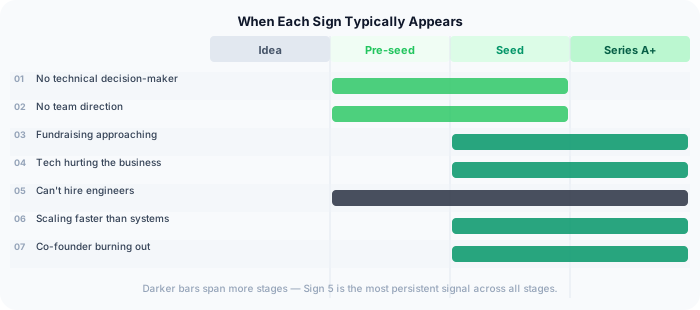
1. You’re Making Technical Decisions You’re Not Qualified to Make
If you’re a non-technical founder choosing tech stacks, approving architecture, or evaluating developer candidates based on whatever you’ve read or what a contractor recommended, that’s a problem. Technical decisions compound. A wrong choice today creates months of remediation tomorrow. You don’t need to understand every technical detail, but you need someone who does and can own the consequences.
2. Your Engineering Team Has No One Setting Direction
If you have developers but no one reviewing architecture, mentoring junior engineers, or pushing back on shortcuts, the team will drift. Inconsistent decisions accumulate, technical debt goes unmanaged, and good engineers leave because there’s no one to learn from. For teams of 1–3 engineers, a fractional CTO or senior engineer can provide enough direction. At 4–10, you need dedicated technical leadership. Past 10, there’s no version of this that works without a full-time technical lead.
3. You’re Approaching a Fundraising Round
Series A investors run technical due diligence. They look at your architecture, your team quality, your development practices, and whether your technical roadmap is credible. Without a technical leader in the room, you often can’t answer the questions that matter most: not because the answers are bad, but because no one has been tracking them. One common failure mode: the investor asks about scalability and the founder gives a confident answer that directly contradicts what the codebase actually shows. A strong technical leader doesn’t just help you pass due diligence. They help you find the gaps before the investor does.
4. Technical Problems Are Affecting the Business
Frequent outages, security gaps, shipping slowdowns, quality issues that customers notice: these don’t get better on their own. The pattern is usually the same: the team fixes the symptom, the same problem resurfaces in a different form, and no one has the authority or the altitude to address what’s actually causing it. A CTO breaks that loop. They diagnose root causes, make the architectural calls that prevent recurrence, and own the outcome rather than just the fix.
5. You Can’t Hire Engineers
If candidates are turning down offers or not applying, ask why before assuming it’s compensation. Often the real answer is there’s no technical leader to work with or learn from. Good engineers think carefully about who they’re betting their next two to four years on. A compelling CTO or technical lead changes the recruiting conversation entirely. Suddenly you’re not just selling equity and mission, you’re selling a person they want to work with. Hiring the technical leader first and letting them help build the team is almost always more effective than trying to recruit without one.
6. You’re Scaling Faster Than Your Systems
Architecture that held up at 100 users breaks at 10,000. Team coordination that worked with 3 engineers doesn’t work with 10. If your growth is outpacing what your systems and processes were designed to handle, you need someone who’s been through that transition before and knows what to fix before it breaks, not after.
7. Your Technical Co-Founder Is Burning Out
If your CTO or technical co-founder is working unsustainable hours, can’t think strategically because they’re in the weeds all day, or is showing signs of burnout, that’s not a personal problem. It’s a structural one. A burnt-out CTO isn’t providing CTO-level value. Options here include hiring a VP of Engineering to handle operational leadership, bringing in a fractional CTO to share the strategic load, or adding senior engineers to reduce the coding burden.
What Type of Technical Leadership Do You Need?
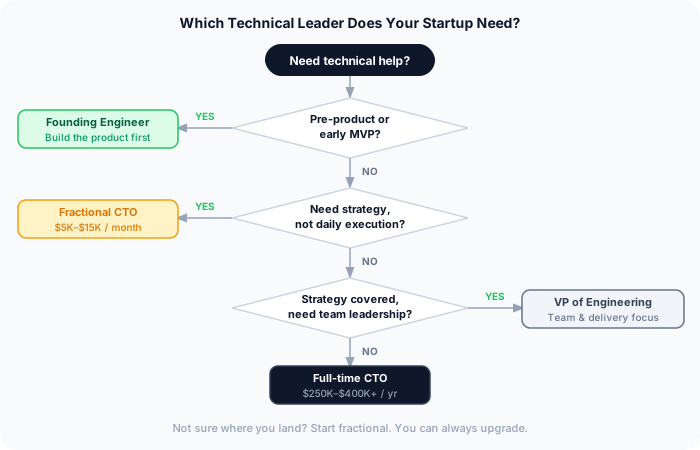
If you’re pre-product or early MVP and just need someone to build, a founding engineer is almost always the right first hire, not a CTO. If you need strategic guidance but not daily involvement, a fractional CTO covers most of what founders actually need at seed stage for $5,000–$15,000/month with minimal equity. If you’re weighing fractional against full-time, that decision has enough nuance to deserve its own read. The comparison guide covers it properly.
A full-time CTO makes sense when technology is core to your competitive advantage, decisions are frequent and high-stakes, and you’re scaling the engineering team rapidly. At seed stage, expect $100,000–$180,000 base salary plus equity in the 2–5% range. Where you land depends on how much of a salary discount they’re taking and how critical their specific background is to your technical direction. At Series A+, total annual cost typically exceeds $300,000. These figures reflect US market rates; Western Europe typically runs 20–30% lower, and Eastern Europe, India, and Latin America can be 40–60% lower. See the full CTO job description for what the role actually covers.
A VP of Engineering is a different hire: right for Series A+ companies that have technical strategy covered but need someone to run the team and own delivery day-to-day. If you’re conflating the two roles, you’re probably at the stage where one person is doing both, and that’s fine until it isn’t.
When You Don’t Need a CTO
If you’re still validating whether customers want what you’re building, CTO-level leadership is probably premature. Test with no-code tools, a simple MVP, or a founding engineer before committing to senior executive overhead.
If you have technical co-founders who are handling it and aren’t overwhelmed, you don’t need to add leadership yet. Add support when you need it, not before.
If you’re using an agency for development, a fractional CTO can provide sufficient oversight without the cost of a full-time hire.
And if budget is extremely constrained, a CTO who drains your runway helps no one. Start with a fractional CTO or a technical advisor and upgrade when the business can support it.
Making the Decision
The clearest signal is usually this: if you can point to specific decisions being made badly, specific engineers leaving, specific deals being lost, or a specific fundraising conversation going poorly because of missing technical leadership, it’s time. Vague discomfort about not having a CTO is rarely enough. Concrete business impact is.
Most of the founders who needed a CTO six months ago knew something was wrong. They just couldn’t name it. If you’re reading this and recognising your company in more than two of these signs, that’s usually answer enough. Start with a fractional CTO if you’re unsure. You can always upgrade.
Not sure what technical leadership you need? Tell us about your situation and we’ll help you figure out the right approach.