A B2B SaaS founder we know spent five months building a full customer management platform before showing it to a single user. When they finally did, users wanted one workflow and found the rest confusing. Three of those five months were wasted on features nobody used. That’s the over-building problem, and it’s far more common than under-building.
What is an MVP?
MVP stands for Minimum Viable Product: the simplest version of your product that lets you learn whether customers want what you’re building.
The key word is viable. An MVP isn’t a broken prototype or a landing page with fake features. It’s a functioning product that delivers real value: just the minimum amount needed to test your core hypothesis.
The Purpose of an MVP
An MVP isn’t about shipping something cheap and fast, though both matter. It’s about learning as quickly as possible: do customers actually want this solution? Will they pay for it? What features matter most? What did you get wrong in your assumptions? Every week you spend building without customer feedback is a week of potential wasted effort.
How to Decide What Goes in Your MVP
The hardest part of MVP development is deciding what to build, and more importantly, what NOT to build. Here’s a framework:
Define Your Core Hypothesis
What’s the one thing you’re trying to prove? Write it down before you build anything: “We believe that [target customers] will [take action/pay money] for [core value proposition] because [reason].” For a concrete example: “We believe that small e-commerce stores will pay $50/month for automated abandoned cart recovery because they’re losing the majority of potential sales and current solutions are too expensive or complex.” Your MVP should test that hypothesis directly. Nothing else.
Identify the Must-Have Features
Ask: what’s the minimum set of features needed to test your hypothesis? For the abandoned cart example, detecting abandoned carts, sending recovery emails, and tracking conversions are essential. SMS recovery, A/B testing, and custom templates are nice to have. Advanced analytics, multi-language support, and integrations with every platform can wait entirely. For each feature you’re considering, ask “Can we test our hypothesis without this?” If yes, cut it.
Manual Before Automated
Many MVPs can use manual processes behind the scenes while presenting a polished interface to users. This is often called a “Wizard of Oz” or “Concierge” MVP. Instead of building complex automation, manually process orders, use spreadsheets instead of databases, send emails by hand, and lean on existing tools like Zapier, Airtable, or Notion. You can replace manual work with automation once you’ve validated demand. There’s no point automating something you haven’t confirmed is worth doing.
Time-Box Your MVP
Set a hard deadline and commit to it. Two to four weeks suits a very constrained MVP where learning speed is everything. Six to eight weeks gives enough time for a functional product. If you can’t ship in twelve weeks, you’re probably not building an MVP. You’re building a full product and telling yourself otherwise. The deadline forces the prioritization decisions that would otherwise get deferred indefinitely.
Choosing Your Tech Stack
One of the most-asked questions from non-technical founders: “What technology should we use?”
The honest answer: it matters less than you think, especially for MVPs. For a deeper look at stack options by stage and product type, see our Startup Tech Stack Guide.
The Right Framework for Choosing
Your tech stack should optimize for four things. First, developer availability: can you find and afford engineers who know it? Second, speed of development: how quickly can you build and iterate? Third, your specific requirements: does your product have unusual technical needs that constrain the choice? Fourth, future scalability, but don’t over-optimize for this early. Most mainstream stacks scale far beyond what early-stage startups need.
Tech Stack Red Flags
A few patterns reliably signal over-engineering. Microservices at the MVP stage always create more coordination overhead than they solve: start with a monolith and break it apart later if the team grows large enough to need it. Kubernetes from day one is similarly premature. Exotic or cutting-edge technologies introduce undocumented failure modes and make future hiring harder than it needs to be. And building custom versions of auth, payments, or email when managed services exist is a mistake. Your time should go to what differentiates your product, not to solved problems.
When Tech Stack Does Matter
Some products have real technical constraints that drive the choice. Real-time collaboration benefits from purpose-built tooling like Supabase or Firebase. AI and ML work lives in the Python ecosystem: that’s not a preference, it’s where the libraries and infrastructure are. Heavy data processing, IoT or hardware integrations, and fintech compliance each have their own legitimate requirements. If your product falls into one of these categories, the stack decision matters. If it doesn’t, optimize for developer familiarity and move on.
MVP Development Costs
The question every founder asks: “How much will it cost to build my MVP?”
The frustrating answer: “It depends.” But here are realistic ranges based on market data and common patterns.
Cost Ranges by Development Approach
| Approach | Cost Range | Timeline | Best For |
|---|---|---|---|
| No-code tools | $0-$5,000 | 2-4 weeks | Simple products, validation |
| Freelance developer | $5,000-$25,000 | 4-8 weeks | Straightforward MVPs |
| Founding engineer | $90,000-$150,000/year + equity | Ongoing | Product-focused startups |
| Development agency | $25,000-$100,000 | 6-12 weeks | Complex MVPs, tight timelines |
| Offshore development | $15,000-$50,000 | 8-16 weeks | Cost-constrained, well-spec’d |
These figures reflect US market rates. Offshore development in India, Eastern Europe, and Latin America typically runs at the lower end of these ranges or below, and can bring a $50,000 project budget meaningfully further if requirements are well-specified before work begins.
The biggest cost driver is complexity: more features, custom design, and third-party integrations all compound. Platform spread (web + iOS + Android from day one) multiplies your budget. The biggest cost reducers are ruthless prioritization, template-based design, building for a single platform first, and investing time in clear specifications before any code is written.
Hidden Costs to Budget For
Beyond development, plan for infrastructure ($50–500/month for hosting, databases, and services), third-party service fees (payment processing runs 2–3%, plus email, analytics, and monitoring), design work ($2,000–$10,000 if you need professional help), legal basics like terms of service and privacy policy ($1,000–$5,000), and testing and QA, which is often underbudgeted (plan for 10–20% of development time).
Realistic Budget Allocation
For a typical $50,000 MVP budget, development takes the largest share at $35,000–$40,000. Design runs $5,000–$8,000. First-year infrastructure and third-party services run $3,000–$5,000. Keep $5,000–$7,000 in contingency for iteration after launch: something will need reworking once real users touch it.
MVP Timeline Expectations
How long should MVP development take? Here’s what’s realistic:
Typical Timelines by Scope
| MVP Complexity | Development Time | Examples |
|---|---|---|
| Simple | 2-4 weeks | Landing page with waitlist, simple booking tool |
| Standard | 6-8 weeks | SaaS with 3-5 core features, marketplace MVP |
| Complex | 10-14 weeks | Fintech app, complex integrations, custom algorithms |
What These Timelines Assume
These timelines assume developers working full-time or close to it, requirements that are clear before development starts, responsive communication from you when questions arise, no major scope changes mid-stream, and use of standard tools rather than building from scratch. Remove any one of those conditions and the timeline extends.
Why Timelines Slip
Unclear requirements cause more delays than any other factor. Developers build what they understood, not what you meant, and fixing the gap after code is written is expensive. Our guide on how to write technical requirements covers this directly. Scope creep is the second most common culprit: “just one more feature” compounds fast when it’s said six times. Third-party API integrations consistently take longer than estimates. Feedback loops (waiting on approvals or decisions) add days that accumulate into weeks. And technical shortcuts taken early create catch-up work that interrupts momentum later.
How to Stay on Track
Set a launch date and commit to it publicly. Keep a prioritized feature list with a hard line between must-haves and nice-to-haves, and don’t let that line move. Meet regularly, either daily standups or at minimum 2–3 times a week. Make decisions quickly when questions come up: slow decisions are how projects drift. And accept “good enough” over perfect: the version in users’ hands will teach you more than the version you’re perfecting in staging.
Build vs. Buy vs. Hire
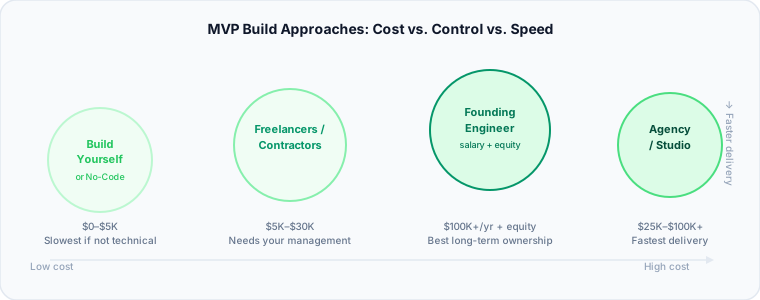
Building yourself is lowest cost but limited by your skills and available time. Freelancers or contractors ($5,000–$30,000) work well for well-defined scope, but require your project management and offer no long-term ownership. An agency ($25,000–$100,000+) gives you a full team and turnkey delivery, at the cost of control and a challenging knowledge handoff when the engagement ends. A founding engineer is the highest-commitment option: they own and evolve the product long-term, but take time to find and require salary plus equity.
Many startups combine these: an agency or freelancer builds the MVP quickly, then a founding engineer joins to own it going forward. A fractional CTO providing architecture oversight while freelancers execute is another common pattern that keeps costs manageable without sacrificing technical judgment.
Common MVP Mistakes
Building Too Much
The most common mistake isn’t shipping something broken: it’s shipping something too large. Founders keep adding features because they’re “easy” or “customers might want them,” and every feature added is more complexity, more bugs, more maintenance. The right bar: does it solve the core problem well enough that your first users will actually use it? If yes, ship it. Everything else is scope creep.
Premature Optimization
Building for scale before you have users is another version of the same error. You don’t need to handle a million users on day one. Build for current needs. If you’re successful enough to hit real scale problems, that’s an excellent problem to have, and you’ll have the resources to address it then.
Ignoring Design
Functional doesn’t mean ugly. Users judge products on appearance, and an unusable interface kills conversions before the product ever gets a fair test. You don’t need custom design work, but you do need competent design. Use an existing design system and move on.
Not Talking to Users First
The most expensive mistake you can make is building what you think customers want instead of what they actually need. Talk to potential users before writing code. Understand their problem well enough that your hypothesis reflects something they’ve actually told you, not something you’ve assumed.
Hiring Wrong
Choosing the cheapest developer, the flashiest agency, or the first person who applied is a common shortcut that costs multiples of whatever was saved. Invest time in evaluation. Check references. Start with a small paid trial project before committing to a full engagement.
No Instrumentation
Shipping without analytics means you’re flying blind. Build in event tracking from day one. You don’t need a complex setup, but you do need to know whether users are signing up, completing key actions, and returning. Without that signal, your iteration decisions are guesses.
Perfectionism
There is always one more thing to fix before launch. Set a date and ship. The version in users’ hands, however imperfect, teaches you more than the version sitting on a staging server.
After the MVP: What Comes Next?
Your MVP is live. Now what?
Measure and Learn
Look at your data with specific questions: are users signing up? Are they completing the core action? Are they returning? What are they saying in feedback? Your next build decisions should come from this signal, not from assumptions made before launch.
Iterate Quickly
Based on what you learn, fix breaking issues first, then improve the core flow, then build the features users are actively requesting. Ship small updates frequently rather than accumulating changes into big releases. The faster the loop, the faster you converge on something that works.
Act on What You Learn
Most founders stay on a failing path too long because they’ve already invested in it. The MVP’s job is to give you data honest enough to override that bias. Strong traction (users engaging, paying, asking for more) means double down. Mixed traction means keep iterating. No signal despite real effort means consider a fundamentally different direction. The most useful thing you can do is make that read accurately, without rationalising away the signal that contradicts what you hoped to find.
Scale When Ready
Only once you have genuine product-market fit signals should you focus on performance optimization, infrastructure scaling, full feature build-out, and growing the team. Premature scaling kills more startups than slow scaling does.
The best MVPs are imperfect products that solve real problems for real users. Ship quickly, learn constantly, and iterate your way to product-market fit.
Ready to build your MVP but not sure where to start? Tell us about your project and we’ll connect you with the right technical help.