Your tech stack decision will affect how fast you can build, who you can hire, how much it costs to run, and how easily you can scale. For most startups, though, it matters less than founders think. What matters more is picking something reasonable, sticking with it, and executing well. The founders who agonize over stack choice for weeks and the ones who pick something sensible in an afternoon tend to ship around the same time.
The Right Framework for Choosing
Before getting into specific technologies, clarify what you’re actually optimizing for.
Developer availability is the most practical constraint: can you find and afford engineers who know this stack? Popular technologies have larger talent pools. Niche technologies require premium salaries or longer searches, and limit your hiring options as the team grows.
Speed of development matters especially at the early stage. Some frameworks prioritize developer productivity; others prioritize performance at the cost of iteration speed. For startups, speed to shipping almost always wins that tradeoff.
Your team’s existing expertise is often the deciding factor. The best technology your team doesn’t know is worse than a good technology they’ve mastered. The exception: if you’re starting completely fresh and can optimize for future hiring, it’s worth thinking about what the market will support.
Specific technical requirements can constrain the choice in ways that override the others. Real-time features benefit from WebSocket-friendly technologies. AI and ML work lives in the Python ecosystem. Heavy computation and compliance-sensitive products each have their own legitimate requirements. If your product falls into one of these categories, the stack decision is less discretionary.
Scalability deserves consideration without over-indexing on it. Avoid technologies with known hard scaling ceilings. But most mainstream options scale far beyond what early-stage startups need, and optimizing for scale you don’t have yet costs you time you don’t have.
The Case for Boring Technology
There’s a persuasive argument that startups should use proven, well-understood technologies rather than the latest innovations. The logic: you have limited engineering bandwidth. Spending any of it on infrastructure rather than product is waste. Proven, widely adopted technologies have known failure modes, extensive documentation, large communities with answers to every edge case question, and large talent pools. Newer, more exciting technologies have the inverse of all of those properties.
For most startups, the boring choice is the right one. Save your innovation budget for what differentiates your product.
Popular Tech Stacks by Product Type
Web SaaS Applications
The most common startup category. You need a frontend, backend, database, and hosting.
The modern JavaScript stack is the most popular choice for a reason. React (or Next.js for full-stack) on the frontend, Node.js with Express or Fastify on the backend, PostgreSQL as the database, and Vercel, Railway, or AWS for hosting. JavaScript everywhere simplifies hiring and enables code sharing between frontend and backend. React dominates the job market. PostgreSQL handles almost any use case. The developer experience is excellent. Best for most SaaS applications, especially those with interactive UIs.
The Python stack is the strongest choice for data-heavy applications and anything touching AI or ML. The backend runs Django or FastAPI (Django for full-featured web apps; FastAPI for APIs and anything involving AI or data), PostgreSQL as the database, hosted on Railway, Render, or AWS. Python is readable, productive, and has the deepest ecosystem for data science and AI work.
Ruby on Rails remains a strong choice for traditional web applications, marketplaces, and content platforms. “Convention over configuration” means fast development for CRUD-heavy applications. The ecosystem is mature, Rails 7 has modern features, and the pattern is well understood.
Go is worth considering for high-performance APIs, infrastructure tools, and DevOps products. Excellent performance, simple explicit code, and strong concurrency support. It compiles to a single binary, which simplifies deployment. The hiring pool is smaller than JavaScript or Python, which is a real tradeoff.
Mobile Applications
Many founders assume they need a mobile app when a well-built responsive web app would serve their users just as well and ship in a fraction of the time. For most startups, that is the right starting point. If you’re validating an idea, your use case doesn’t require native features like camera or push notifications, or you want to minimize initial investment, build for web first and add native later when you know it’s needed.
When mobile is genuinely required, cross-platform development is the right default: React Native if you have React web developers (JavaScript/TypeScript, share code with web, large job market), or Flutter if you’re starting fresh and prioritize highly custom UI (excellent performance and consistency, growing rapidly). Choose native iOS (Swift with SwiftUI) or Android (Kotlin with Jetpack Compose) only when performance is critical, deep platform integration is required, and the budget allows for separate iOS and Android teams.
AI/ML Applications
Python is non-negotiable for AI. The stack: FastAPI on the backend, PyTorch or TensorFlow for the ML framework, HuggingFace or Modal or Replicate for model serving, Pinecone or Weaviate or pgvector as the vector database, and React/Next.js on the frontend. Use managed services (OpenAI, Anthropic) rather than hosting your own models unless you have a specific reason not to. GPU hosting is expensive, and for most early-stage products, the managed API is the right default.
Data-Intensive Applications
Separate your transactional and analytical workloads from the start. Apache Spark, dbt, or Dagster for data processing; Snowflake, BigQuery, or PostgreSQL for the data warehouse; FastAPI or Go for the API layer; React with a charting library on the frontend. Use managed data warehouses over self-hosted. Time-series data may benefit from specialized databases like TimescaleDB.
Tech Stack by Company Stage
At the pre-seed and MVP stage, optimize for speed and simplicity. The fastest path to a working product: Next.js for full-stack React, PostgreSQL via Supabase or Neon, Vercel or Railway for hosting, Clerk or Auth0 for authentication. Avoid microservices, Kubernetes, and custom infrastructure. You can always change later; right now you need to ship.
At the seed stage, double down on what’s working. Solidify the MVP stack if it’s serving you. Add proper CI/CD (GitHub Actions), monitoring (Sentry, Datadog), and a queue system (Redis, SQS) if the product needs it. Don’t rewrite for scale you don’t have.
At Series A and beyond, you may need to address real performance bottlenecks, break apart a monolith as the engineering team grows, and invest seriously in monitoring, observability, security, and compliance. The key principle remains the same: solve actual problems, not theoretical ones.
Common Tech Stack Mistakes
Premature optimization is the most common error. Building for millions of users when you have hundreds slows you down now and adds complexity you may never need. Most scalability problems are good problems: you’ll have resources to address them if you actually reach that scale. Build simple, measure actual performance, and optimize when the measurement says you need to.
Microservices too early is a specific version of the same mistake. Distributed systems add massive coordination overhead: separate deployment, monitoring, and debugging for each service. A well-structured monolith can scale further than most startups will ever need. Start with a monolith. Extract services when team coordination, not technical performance, becomes the bottleneck.
Exotic technology choices feel exciting when you make them and create problems throughout the life of the product. Edge cases are undocumented. Finding help is harder. Hiring is harder. The technology may not survive. Use boring, proven technologies and save the innovation budget for your product.
Building infrastructure instead of product is another way to spend engineering time on the wrong things. Custom auth, custom deployment, custom monitoring: these are solved problems that managed services handle better. Build only what’s core to your value proposition.
Ignoring the hiring market when making the stack choice creates a constraint that compounds. Niche technologies limit hiring options. Popular technologies have competitive, available talent pools. Check the job market before committing.
Decision Shortcuts
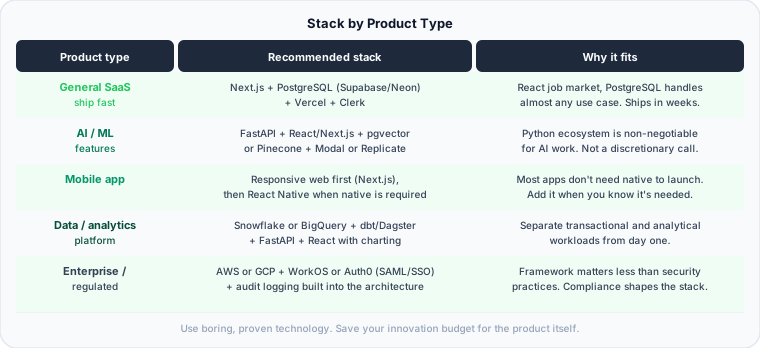
If you just want to ship: Next.js with PostgreSQL via Supabase or Neon, Clerk for authentication, Vercel for hosting. Ships in weeks, scales to millions.
If you’re building AI/ML: FastAPI on a Python backend, React/Next.js on the frontend, PostgreSQL with pgvector or Pinecone, Modal or Replicate for model hosting. Python is non-negotiable for AI.
If you need mobile: Start with a responsive web app in Next.js. Add React Native when mobile-specific features are genuinely needed. Consider native only for performance-critical use cases.
If you’re enterprise or regulated: SOC 2 compliant hosting (AWS or GCP with proper configuration), strong authentication via SAML/SSO (WorkOS or Auth0), audit logging built into the architecture, encryption at rest and in transit. Framework choice matters less than security practices.
Changing Your Stack Later
Successful companies change stacks. It’s painful and expensive, but it’s survivable. The way to minimize that pain is to make reasonable initial choices, avoid optimizing for hypothetical scale, accept that some technical debt is normal, and plan for evolution rather than perfection.
The best tech stack is one you can execute well. Make a reasonable choice, commit to it, and focus on building a product people want. For more on the overall build process, see our MVP Development guide. If you’re a non-technical founder navigating these decisions, consider pairing with a founding engineer who can own these choices.
If you’re about to commit to a stack and want a technical review before you build on it, that’s exactly what a fractional CTO engagement is for. Get matched and we’ll connect you with someone who’s made these decisions before.