You’ve made it past the partner meeting. The term sheet is looking likely. Then you hear those words: “We’d like to conduct technical due diligence.”
For many founders (especially non-technical ones) this triggers panic. What will they find? What do they even look for? How do you prepare?
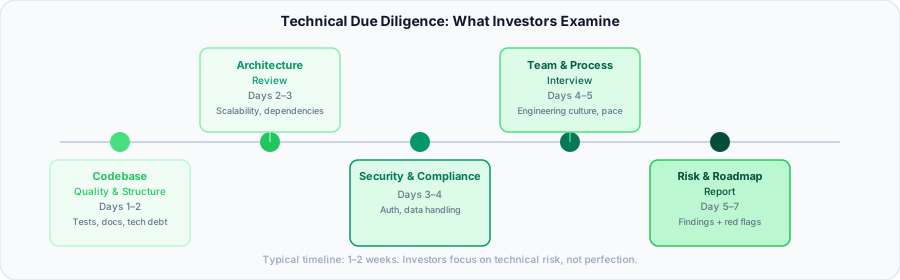
What is Technical Due Diligence?
Technical due diligence is an assessment of a company’s technology, engineering team, and technical processes. It’s typically conducted by investors before finalizing an investment, or by acquirers before completing an acquisition.
The goal isn’t to find perfect code (that doesn’t exist). The goal is to verify claims made during fundraising, identify risks that could affect the investment, and assess whether the team can actually execute the roadmap.
In our experience, investors treat TDD as a deciding factor more often than founders expect. It’s become less of a formality and more of a genuine filter.
Who Conducts Technical Due Diligence?
Depending on the investor and deal size:
- Internal technical partners at the VC firm
- Portfolio company CTOs asked to review as a favor
- Third-party consulting firms specializing in TDD
- Independent technical advisors hired for the assessment
Larger deals (Series B+) typically involve more formal, structured assessments. Seed-stage deals may be informal conversations with a technical partner.
What Investors Look For
Code Quality and Architecture
They want to know whether the codebase is maintainable, whether there’s consistent structure and standards, and whether the architecture can grow with the business. They don’t expect zero technical debt. They do expect you to know where it is and have a plan for it.
The most common version of this going wrong: a founder describes their system as “highly scalable” and the assessor finds a database query running on every page load with no indexing. It’s not a dealbreaker on its own, but it signals that no one has been watching the code critically. Red flags: spaghetti code with no discernible structure, no version control, or architecture that fundamentally can’t grow.
Security and Data Protection
Basic encryption (in transit and at rest), authentication controls, and awareness of compliance requirements (GDPR, CCPA) are table stakes. They’re not expecting a SOC 2 audit at seed stage, but they are expecting that you haven’t stored passwords in plaintext or left user data exposed. Any prior security incidents should be disclosed along with what you learned.
A common surprise: founders discover during TDD that third-party API credentials were committed directly to the repo at some point. The issue isn’t the mistake itself. It’s whether you found it before they did. Going in knowing your own vulnerabilities is very different from being caught unaware.
Infrastructure and Operations
Can you deploy reliably? Is anyone watching when things break? They look for automated deployments, basic monitoring and alerting, and some ability to recover from failures.
If the assessor asks “what happened the last time you had an outage” and the honest answer is “I’m not sure we’d have noticed unless a customer called,” that’s a signal about operational maturity that will appear in the report. You don’t need a perfect track record. You need evidence that you’re paying attention.
Development Processes
How does code get from idea to production? They want to see code review before merging, some automated testing on critical paths, and a release cadence that’s regular rather than rare and painful.
One pattern that surfaces repeatedly in early-stage TDD: code shipped directly to production with no review trail. It’s forgivable at very early stage. By the time you’re raising a Series A, it reads as a discipline gap. Have a process you can walk them through, even a lightweight one.
Team and Knowledge Distribution
Does the team have the skills the roadmap actually requires? Is critical knowledge spread across the team or concentrated in one person? Single points of failure (technically or organizationally) are a significant risk signal.
The “bus factor” question (what happens if a key person leaves) comes up in almost every TDD conversation. If the honest answer is “we’d be stuck,” that will appear in the report. It won’t kill the deal on its own, but it shapes the terms conversation.
Product and Roadmap
Is what you’ve built stable enough to build on? Is the roadmap technically feasible and are the estimates grounded in reality? Wildly optimistic timelines or a roadmap that requires impossible technology are red flags. Known risks with mitigation plans are fine.
One of the more uncomfortable TDD moments: the investor asks about a roadmap item, and the founder gives a confident timeline that their own engineer would privately say is off by three times. Investors notice when founders and engineers aren’t aligned on what’s realistic. Before TDD, get in the room with your technical lead and pressure-test every estimate.
How to Prepare
Start early. Don’t wait for the term sheet. In the months before fundraising, document your architecture and key technical decisions, address obvious security gaps, and clean up the most visible technical debt.
Be honest about issues. Investors expect imperfect code. What they don’t tolerate is hiding significant problems, being unaware of them, or having no plan to address them. If you have debt, name it and explain the plan. If you’ve had a security incident, disclose it.
Have technical leadership in the room. TDD conversations need someone who can walk through architecture decisions, explain the roadmap’s feasibility, and answer detailed technical questions. If you’re non-technical, consider bringing a fractional CTO for the process.
Set up a data room. Prepare a secure folder with the documentation investors will want: an architecture diagram, tech stack overview with rationale, infrastructure documentation, security practices, development process overview, team structure, roadmap with technical milestones, and a summary of known technical debt with remediation plans. Also have read-only repository access ready, uptime metrics, and incident history.
Know the answers before they ask. Prepare honest answers to: “Why did you choose this tech stack?” “What’s your biggest technical risk?” “How would you handle 10x growth?” “What happens if [key person] leaves?” These come up in almost every TDD conversation.
What Happens During TDD
The process typically runs: kickoff call to align on scope and access, documentation and code review, technical interviews with your engineering team, infrastructure and security assessment, and a findings presentation with a chance to respond to anything raised.
| Stage | Typical Duration |
|---|---|
| Seed stage | 1–2 weeks (often informal) |
| Series A | 2–4 weeks |
| Series B+ | 4–8 weeks |
Passing vs. Failing TDD
There’s rarely a binary pass/fail. Investors use TDD to confirm the deal, adjust terms, add conditions, or in serious cases, walk away. Most companies pass with observations and recommendations. The bar is “appropriate for stage with reasonable plans,” not perfection.
What actually kills deals:
- Material misrepresentation: you said X, reality is Y
- Undisclosed liabilities: security breaches, compliance violations
- Fundamental technical risk: the product can’t do what’s claimed
- Team capability gaps: nobody on the team can build what’s on the roadmap
- Insurmountable technical debt that requires a complete rewrite to proceed
What doesn’t kill deals:
- Normal technical debt
- Missing documentation
- Some process gaps
- Skills gaps with a realistic hiring plan
- Infrastructure that needs improvement but has a clear path forward
TDD isn’t meant to catch you out. It’s meant to give investors confidence. Approach it as a chance to show you understand your own risks clearly. A fractional CTO can help you prepare for and navigate the process. See when to hire a CTO to understand if you need technical leadership before your next round.
Preparing for a fundraising round? Get matched with experienced technical leaders so you go into the room prepared, not reactive.