A CTO job description written for a 5-person startup and one written for a 500-person company should look completely different. Most don’t. Founders use the same template, get candidates who don’t fit the stage they’re at, and wonder why the hire failed.
The CTO role moves through distinct phases as a company grows. Early-stage CTOs are builders: they write the majority of the code, make architectural calls, and set up the infrastructure the team will build on. Growth-stage CTOs are operators: they’re hiring, building management structure, and stepping back from daily coding while still owning technical decisions. Late-stage CTOs are executives: their time goes to technology vision, board communication, strategic partnerships, and organizational design. Most CTOs move through all of them. The mistake is hiring for the wrong phase.
What Does a CTO Do?
A Chief Technology Officer is responsible for a company’s technology strategy and its execution: ensuring technical decisions support business goals, the engineering team can deliver, and the company builds the capabilities it needs to compete. But that definition is stage-dependent in ways that matter enormously when you’re writing a job description or evaluating candidates.
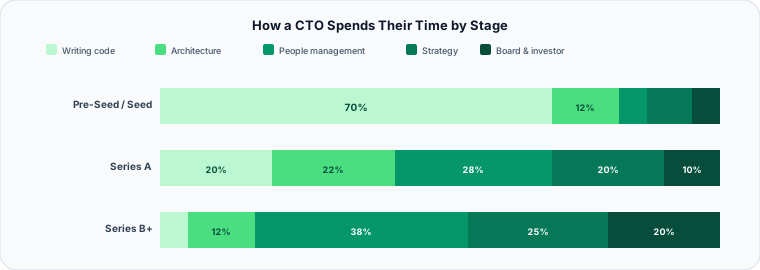
CTO Responsibilities by Company Stage
Pre-Seed / Seed Stage (1–10 employees)
At this stage the CTO is, in practice, the technical co-founder. They write code 60–80% of the time, make foundational architecture decisions, choose the initial tech stack, and set up development infrastructure while participating in customer conversations and contributing technical sections to fundraising materials. The skills that matter most here are strong full-stack engineering ability, speed, pragmatism, and the ability to communicate clearly with non-technical co-founders. Leadership experience is secondary to the ability to ship.
Series A Stage (10–30 employees)
The transition from builder to leader begins. Code contribution drops to 30–50% of their time. The rest goes to hiring and managing the first engineering managers, establishing culture and process standards, making build-vs-buy calls, preparing for technical due diligence, and building board relationships. This is the stage where people management and process design become load-bearing skills, and where CTOs who can only build often struggle most.
Series B–C Stage (30–100+ employees)
The CTO is now a full executive. Hands-on coding is minimal (0–10%, mostly architecture reviews). Most of their time goes to leading engineering teams through managers, setting technical strategy and roadmap, managing technical debt and platform evolution, owning security and compliance programs, handling engineering budget, and working with other executives on company direction. External representation (conferences, recruiting events, partnerships) becomes a meaningful time commitment. Scaling engineering organizations is the primary skill required.
Enterprise / Public Company Stage
Strategy and organizational scale dominate. The CTO sets multi-year technology vision, manages engineering budgets that can run into the tens or hundreds of millions, represents the company to investors and media, and leads M&A technical evaluation. Executive presence and board-level credibility are as important as technical judgment at this stage.
Key CTO Responsibilities
Technology strategy is the most abstract part of the role and the one most often underdefined in job descriptions. A CTO answers the question of what technical capabilities the company needs to compete: what to invest in, what to buy rather than build, and where to place bets on technical direction. At early stages this is mostly architectural. At later stages it involves vendor evaluation, platform decisions, and roadmaps spanning multiple years.
Team building and culture set the foundation for everything else. The CTO recruits engineering talent, defines the values the team operates by, creates career paths that give people a reason to stay, and addresses underperformance when it arises. Employer brand for engineering recruiting, interview process design, and onboarding programs all sit here. This is the work that determines whether strong engineers join, grow, and stay.
Product and engineering alignment is the translation function. The CTO works with product leadership to prioritize the roadmap, balances feature work against technical debt, ensures engineering capacity matches product ambitions, and manages stakeholder expectations around timelines. When product wants something the team can’t deliver in the time proposed, the CTO owns that conversation honestly.
Security and compliance become load-bearing as the company grows. The CTO owns the security program, ensures regulatory compliance (GDPR, SOC 2, HIPAA depending on the market), manages the response when incidents occur, and evaluates vendor security posture. For companies selling to enterprise customers or operating in regulated industries, this often determines whether deals close.
Operations and reliability is accountability for keeping what’s been built working. The CTO owns system uptime, incident response procedures, infrastructure costs and efficiency, and the architectural decisions that allow systems to scale under load.
CTO Salary and Compensation
CTO compensation varies significantly based on company stage, location, and industry. The ranges below reflect US market rates. Western Europe typically runs 20–30% lower; markets in Eastern Europe, India, and Latin America can be 40–60% lower for comparable experience.
Base Salary Ranges (US Market)
| Company Stage | Base Salary Range |
|---|---|
| Pre-seed/Seed | $100,000–$180,000 |
| Series A | $180,000–$250,000 |
| Series B-C | $250,000–$350,000 |
| Late-stage/Public | $300,000–$500,000+ |
Total Compensation
Total compensation including equity and bonuses varies significantly by stage. At seed, expect $150,000–$300,000 with heavy equity weighting. At Series A, that range moves to $300,000–$500,000. Series B–C sees $400,000–$750,000. At public companies, total comp often exceeds $700,000 and can reach $2M or more at top-tier companies.
Equity Expectations
| Stage | Typical CTO Equity |
|---|---|
| Co-founder CTO | 15-35% (pre-dilution) |
| First CTO hire (pre-seed) | 3-8% |
| Series A CTO hire | 1-3% |
| Series B+ CTO hire | 0.5-1.5% |
CTO Job Description Templates by Stage
The job description you post should reflect where you actually are, not where you hope to be. A seed-stage CTO and a Series B CTO have meaningfully different jobs. Here are three versions to adapt.
Seed Stage CTO (1–10 people)
You’ll write code most of the day: expect 60–80% of your time to be hands-on building. Beyond that: make foundational architecture decisions, choose and own the tech stack, set up development infrastructure, participate in customer conversations, and contribute to fundraising materials. This is an engineering role that happens to sit at the executive level.
We’re looking for someone with 5+ years of engineering experience, ideally with full-stack coverage and at least one startup in their background. Big-company credentials matter less than speed, pragmatism, and the ability to make architectural calls without a committee. You should be able to explain technical tradeoffs clearly to a non-technical co-founder and be comfortable with requirements that change every week.
Compensation: $100,000–$180,000 salary. Equity: 3–8% at pre-seed, 1–3% at seed. Add your specific stack and any hard requirements before posting.
Series A CTO (10–30 people)
You’ll build and lead the engineering team as it grows from a small group to 15–30 people. Code contribution drops to 30–50% of your time as you take on your first engineering managers, establish culture and process standards, prepare for technical due diligence, and make build-vs-buy calls that shape the roadmap. This is where the transition from builder to leader happens: the role requires both, in shifting proportion.
We’re looking for someone with 8+ years of engineering experience and at least 2 years of engineering leadership. You’ve hired engineers before and have a clear point of view on what good engineering culture looks like. You can hold a technical conversation with the board and a product conversation with the CEO on the same day.
Compensation: $180,000–$250,000 salary. Equity: 1–3%. Total compensation typically $300,000–$500,000 including equity value.
Series B+ CTO (30–100+ people)
You’ll lead engineering through managers, not directly. Set technical strategy and multi-year roadmap, manage technical debt and platform evolution, own security and compliance programs, handle the engineering budget, and work with the executive team on company direction. Hands-on coding is minimal: mostly architecture reviews and judgment calls on the highest-stakes technical decisions.
We’re looking for someone with 12+ years of engineering experience and a demonstrated track record of scaling engineering organizations through growth. You’ve managed managers. You can represent the company credibly through technical due diligence, set a direction that teams can execute against over multiple years, and develop senior technical talent.
Compensation: $250,000–$350,000 salary. Equity: 0.5–1.5%. Total compensation typically $400,000–$750,000 at this stage.
What to Look for When Hiring a CTO
Stage-Appropriate Experience
The most common CTO hiring mistake is bringing in someone whose experience doesn’t match the stage you’re actually at. A CTO from a 500-person company who hasn’t written production code in years will struggle at a 10-person startup where coding is most of the job. An excellent senior engineer may lack the leadership and strategic skills needed to scale a team. Look for candidates whose most recent experience matches your current stage and one level of growth beyond it, not three levels beyond it.
Technical Credibility
Your CTO needs enough technical depth to earn the respect of engineers, make sound architectural decisions, evaluate technical talent accurately, and understand the downstream implications of the choices they make. Evaluate this through system design and architecture discussions in the interview, reference checks specifically with engineers they’ve managed, and direct conversation about technical decisions they’ve made in the past and why. If they can’t explain past architectural tradeoffs clearly, that’s a signal worth taking seriously.
Leadership and Communication
Technical ability alone doesn’t make a CTO effective. They need to translate technical realities to non-technical stakeholders, build trust with the board and investors, inspire and retain engineering talent, and navigate conflict when technical and business priorities collide. Evaluate directly: watch how they explain technical concepts to you in your first conversation, run behavioral interviews on leadership situations they’ve actually faced, and check references with non-technical peers and direct reports, not just other CTOs.
Cultural Fit
The CTO sets the tone for engineering culture in ways that outlast their tenure. Look for genuine alignment on work style (how hands-on versus delegating), risk tolerance (speed versus care), and the values they model when things go wrong. This isn’t about personality. It’s about whether their operating style matches what the company actually needs at this stage.
Red Flags When Hiring a CTO
A CTO who can’t explain technical concepts simply is a problem before they start. Complexity as a shield usually indicates unclear thinking, not depth. A candidate who has only led large engineering organizations without hands-on experience at your stage often lacks what you actually need: managing 100 engineers is a different job from building with 5. Watch for blame: someone who consistently attributes past failures to the team rather than to decisions they made is showing you how they’ll operate under pressure. Technology dogmatism (insisting on specific technologies before they understand your context) signals they’ll optimize for their preferences rather than your needs. A candidate who can’t clearly articulate why they want this specific role at this specific stage isn’t a fit: “I want to be CTO” isn’t a reason. And poor references from engineers they’ve managed matters more than any other signal. The team’s experience is the most honest data you’ll find.
CTO Alternatives
A full-time CTO isn’t always the right answer. A fractional CTO works part-time (typically 10–20 hours a week) and suits early-stage companies that don’t yet need full-time executive leadership, companies bridging between technical leaders, or specific engagements like due diligence preparation or architecture review. The Fractional vs Full-Time CTO guide covers how to choose between the two.
Some companies split the role: a VP of Engineering handles day-to-day team leadership and delivery, while a part-time technical advisor provides strategic input at the executive level. This works well when you have operational engineering leadership covered but need senior judgment on the big calls.
For pre-product companies that need building more than leadership, a founding engineer is typically the better first hire. They cost less, write more code, and grow into technical leadership over time rather than arriving as a leader without a team.
The right CTO can transform your company’s technical trajectory. The wrong one can set you back years. When in doubt, weight references from engineers they’ve actually managed above everything else in the process: the team’s experience is the most honest data you’ll find. If you’re still deciding whether it’s the right time, read When to Hire a CTO for the specific signals to watch for.
Need help finding the right technical leadership for your stage? Get matched with vetted CTOs, fractional leaders, and founding engineers.