You’ve probably already used AI to build something. A feature, a prototype, maybe a whole MVP. It worked. It was fast. And now you’re wondering whether you actually need to pay someone $8,000–$15,000 a month to think about your technology when a chatbot can write the code in seconds.
It’s the right question. The honest answer: AI has made certain things dramatically cheaper, and it’s made the cost of getting the other things wrong dramatically higher.
What AI Is Actually Good At
AI coding tools genuinely accelerate development. A developer who needed two weeks to build a feature can often ship it in four days. Boilerplate is gone. Prototyping is faster. Non-technical founders are using tools like Cursor, v0, and Replit to get working products in front of users without writing a line of code themselves.
That’s real. If you’re pre-product and trying to validate a hypothesis, AI tools have meaningfully lowered the barrier to getting something into users’ hands.
But getting something into users’ hands is not the same as building a company.
The Decisions AI Cannot Make
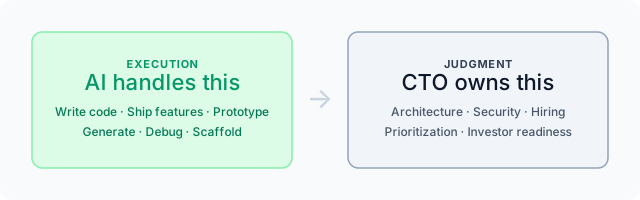
Every technical situation has two parts. The first is execution: write the code, ship the feature, deploy the fix. AI is fast and capable here.
The second is judgment: what to build, in what order, at what cost, and what breaks if you get it wrong. That part is entirely untouched.
Here’s what judgment looks like in practice:
Your cloud bill just jumped 3x in a month. Is that normal growth or is something misconfigured? The answer requires someone who understands your architecture, your traffic, and the difference between a $500 fix and a $50,000 infrastructure rewrite. AI can generate theories. It can’t tell you which one is actually happening in your system.
You’re interviewing two engineers. One has an impressive portfolio but has only worked at large companies. The other has scrappier experience but has shipped products at your stage. AI doesn’t know what your current stage requires. A fractional CTO does, because they’ve hired for it before.
Your authentication provider just changed its pricing model and it’s going to cost you $4,000 a month more. Do you rebuild it in-house, switch providers, or absorb the cost? That decision depends on your runway, your roadmap, your team’s capacity, and the risk of touching core auth mid-product. It’s not a coding question. It’s a business judgment call that requires technical fluency.
These aren’t edge cases. They’re the decisions that show up every quarter once you have real users and real infrastructure.
Why Moving Fast Without Direction Is Dangerous
Here’s the part most founders don’t see coming: AI doesn’t just speed up good decisions. It speeds up bad ones too.
Before AI tools, a small team took weeks to ship a feature. That pace created natural checkpoints. People noticed problems before they became structural. There was usually one developer who understood why every decision was made.
AI removes those checkpoints. You can generate a working authentication system in an afternoon. If it has a security gap, it’s in production by end of day. You can prototype three new features in a week. If they’re built on the wrong architectural assumptions, you’re six months away from a rewrite that costs you the same time you thought you saved.
Speed compounds. That’s good when you’re pointed in the right direction and catastrophic when you’re not.
What a Fractional CTO Actually Protects You From
A fractional CTO typically works 8–20 hours a week with your company, costs $5,000–$15,000 a month depending on experience and scope, and owns the judgment layer AI cannot touch.
Before you build anything significant, they review whether the technical approach will hold up at 10x your current scale, or whether you’re 18 months away from a full rewrite that costs you everything you gained. That conversation, had early, saves six figures. Had late, it’s the conversation that explains why the last year of work has to be redone.
On security: a single missed vulnerability in how you handle user data doesn’t just mean a breach. It means losing the enterprise pilot you spent four months closing because you failed their security review. Most early-stage teams don’t have the depth to catch these gaps. A fractional CTO is specifically looking for them.
On hiring: a bad senior engineer hire costs you more than the salary. Factor in onboarding, the work they shipped that needs to be undone, and the four to six months it takes to recognize the problem and recover from it, and a single wrong hire at the $150,000–$180,000 level runs $250,000 or more all-in. You cannot evaluate technical candidates without technical judgment. A fractional CTO interviews them, reviews their work, and tells you who’s actually worth the bet.
On investor readiness: Series A investors run technical due diligence. They want to understand your architecture, your team quality, your security posture, and whether your roadmap is credible. Founders who go into those conversations without a technical leader prepared alongside them often lose deals they should have won, not because the product wasn’t good, but because they couldn’t answer the questions confidently.
And on prioritization: every startup has more to build than time to build it. Left to developers alone, that decision defaults to whatever is technically interesting. A fractional CTO makes it based on what actually moves the business.
When You Can Skip It (and When You Can’t)
If you’re pre-seed, building a prototype to test whether the problem is real, AI tools are enough. You don’t need senior technical leadership to run a product experiment.
Once you have paying users, real data, and engineers on the payroll, the calculus shifts. Technical failures aren’t learning opportunities at that stage. They’re churn events, security incidents, and six-figure infrastructure bills. The decisions you defer don’t go away. They accumulate.
Having no technical leadership at that point isn’t a lean choice. It’s a bet that nothing will go wrong. That bet usually holds until it doesn’t, and when it doesn’t, the cost is rarely just money.
If you already have a founding engineer, that’s a start, but it’s not the same thing. A founding engineer builds. A fractional CTO decides what to build, in what order, and whether the architecture underneath it will hold. Most early teams need both.
Your Time Is the Real Variable
Even if AI could answer every technical question, it still takes your time to ask them, evaluate the answers, and make the call. That time has a cost. Your leverage as a founder is in understanding your customers, shaping your product, and building the relationships that move your business forward. Every hour you spend covering a technical gap that someone else should own is an hour taken from the work only you can do.
AI generates answers to prompts. A fractional CTO answers for what happens next, so you don’t have to.
If you have paying users, engineers on payroll, and no one who can tell you whether what’s being built is the right thing, you’re already past the threshold. Get matched with a fractional CTO. The conversation is free and you’ll have a clear answer within 24 hours.