The full-time CTO price tag stops most founders: $250,000–$400,000 base salary, plus equity, plus 3–6 months to find the right person, plus severance risk if it doesn’t work out. The fractional model solves the cost problem. What it doesn’t solve is a team that needs daily leadership, or a product where technology is the actual competitive advantage. Founders who go fractional in those situations usually figure it out six months later, when engineers are leaving and decisions are backing up. The reverse is just as common: companies that hire full-time at seed stage because it felt more serious, then burn runway on a role they didn’t need yet.
The question isn’t which is cheaper. It’s which one your startup actually needs right now.
At a Glance
| Fractional CTO | Full-Time CTO | |
|---|---|---|
| Time commitment | 5–20 hours/week | 40–60+ hours/week |
| Monthly cost | $5,000–$15,000 | $20,000–$40,000+ |
| Annual cost | $60,000–$180,000 | $250,000–$500,000+ |
| Equity | 0–0.5% | 1–5%+ |
| Availability | Scheduled and async | Always available |
| Team integration | Partial | Full |
| Commitment | Flexible, month-to-month | Multi-year, with severance risk |
When Fractional Makes Sense
Most early-stage startups don’t have enough CTO-level work to justify full-time leadership. If you’re pre-seed or seed with a small engineering team, the strategic decisions (architecture direction, tech stack, hiring approach, investor prep) don’t fill 40 hours a week. A fractional CTO covers that work at a fraction of the cost, and can start immediately without a months-long search.
Fractional also makes sense when you’re approaching fundraising and need to sharpen your technical story without a permanent commitment. A 3–6 month engagement to prepare for Series A, tighten your architecture narrative, and run technical due diligence is a well-scoped problem that doesn’t require a full-time executive.
If you already have a strong VP of Engineering or technical lead who owns execution, what you’re missing is strategic oversight: someone who represents technology at the board level, makes the big architectural calls, and brings credibility to investor conversations. A fractional CTO fills that gap without duplicating operational leadership you already have.
The other clear case: your CTO just left and you need an interim CTO while you hire. A fractional engagement in this mode stabilizes the team, keeps decisions moving, and can help define and recruit the permanent role — without the risk of a rushed full-time hire.
When Full-Time Makes Sense
If technology is your actual competitive advantage, not just the vehicle for your product but the product itself, you need someone in it full-time. An AI company whose model is the moat, a security company whose detection logic is proprietary, a data company whose pipeline is what customers are paying for: these require a CTO who lives in the technology every day.
Full-time also becomes necessary when you’re scaling the engineering team fast. Going from 5 engineers to 30 in a year requires daily presence: in hiring loops, in architecture reviews, in the culture you’re building as you bring people on. A fractional CTO can advise on that process but can’t own it at part-time availability.
When your engineering team is still forming and needs someone present, someone they can pull into a decision and who’s building trust daily, fractional availability isn’t enough. Scheduled check-ins don’t substitute for consistent leadership when the team is junior or under pressure.
A useful self-check: how many hours a week does your team actually need a CTO-level decision or intervention? If the answer is consistently above 20, you’ve likely outgrown the fractional model. Other signals worth watching: urgent decisions are piling up between scheduled calls, the team is growing faster than a part-time leader can stay on top of, or your fractional CTO keeps flagging things they’d handle differently with more time. Any of those is the cue to upgrade.
The Hybrid Approach
Some companies split the role. A fractional CTO handles strategy, investor communication, and architectural oversight. A VP of Engineering owns execution: hiring, team management, delivery, and day-to-day process. This works well when operational leadership is in place but you need a senior technical voice at the executive level.
It also works as a bridge. Start fractional, validate that you need full-time leadership, define the role with more clarity, then hire. Some fractional CTOs move into the full-time role once the relationship is proven. That’s often a lower-risk path than a cold external search.
What It Actually Costs
For a Series A startup over 12 months, the numbers look like this.
| Cost category | Fractional CTO | Full-Time CTO |
|---|---|---|
| Base / retainer | $120,000/yr | $275,000/yr |
| Recruiting | $0 | $55,000 |
| Equity (2% at $20M) | $0 | $400,000 |
| Total year 1 | $120,000 | $730,000 |
Full-time costs roughly 6x more in year one when equity is included, and 2.3x more in cash alone. But that comparison only matters if fractional actually meets your needs. If you need full-time availability and deep team integration, the premium is worth it.
These figures reflect US market rates. Western Europe typically runs 20–30% lower. Eastern Europe, India, and Latin America can be 40–60% lower for both models, worth factoring in if you’re hiring or operating outside the US.
One cost most founders underweight: the equity component. A 2% grant at a $10M valuation is $200,000 today. At a $100M outcome, it’s $2M. That’s real cost even if it doesn’t hit the bank account immediately.
How to Decide
If you can’t point to a specific decision your fractional CTO can’t make at part-time availability, you probably don’t need full-time yet. That’s the real test: not stage, not headcount, not what other companies your size are doing.
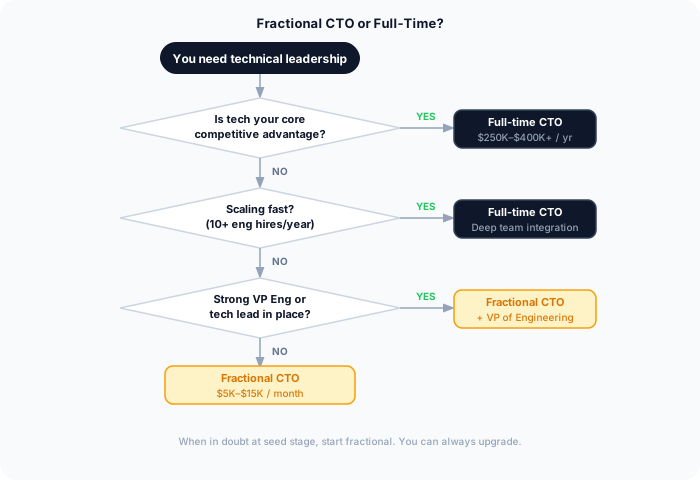
If you’re still on the fence, the default answer at seed stage is almost always fractional. Start there, validate the need, and upgrade when the business demands it. For a fuller picture of what each model looks like in practice, see the fractional CTO guide and What Does a CTO Do. If you’re writing a job description or preparing to hire, see CTO job description templates by stage. For a broader view of when to bring in technical leadership at all, see When to Hire a CTO.
Going fractional when you need full-time means decisions stalling and engineers leaving. Going full-time before you’re ready means burning runway on a role that doesn’t earn its cost yet. Both are avoidable if you’re honest about what your company actually needs right now.
Not sure which model fits your situation? Tell us about your startup and we’ll help you figure out the right approach.