In the world of software engineering, most developers work on products that millions of users will eventually touch, but never meet. Forward Deployed Engineers (FDEs) are different. They sit directly with customers, solving their specific problems in real time.
The role was pioneered by Palantir and has since spread to companies like Databricks, Scale AI, Notion, and dozens of high-growth enterprise software startups. It isn’t widely understood outside the companies that use it, which makes it hard to evaluate whether it’s right for you, or whether you should be hiring for it.
What is a Forward Deployed Engineer?
A Forward Deployed Engineer (FDE) is a software engineer who embeds directly with customers to implement, customize, and deploy software solutions to solve their specific business problems.
Unlike traditional software engineers who build features for a broad user base, FDEs focus on one customer at a time. They work on-site (or closely integrated remotely) with the customer’s team, understanding their workflows, data, and challenges, then building production-ready solutions using their company’s platform.
The term “forward deployed” comes from military terminology: troops stationed at the front lines rather than at base. FDEs are the engineering equivalent, at the customer instead of at headquarters.
What Does a Forward Deployed Engineer Do?
The day-to-day work blends software engineering with consulting and customer discovery in ways most engineers never experience. It starts with immersion: not collecting a requirements doc, but spending real time in the customer’s world. Interviewing stakeholders across departments. Watching how people actually work, not how they say they work. Surfacing problems the customer hasn’t been able to name yet. That understanding shapes everything that comes after.
From there, FDEs design and build. Not prototypes or demos. Production systems that run customer business processes, often handling mission-critical workflows. They have significant architectural autonomy, making technical decisions appropriate to each customer’s context without waiting for specs to land in their inbox. When the code is written, they own deployment, monitoring, and iteration. When something breaks in production, they’re the ones getting the call.
Two responsibilities define whether an engagement is truly successful. The first is knowledge transfer: training customer teams, writing documentation, building enough internal capability that the customer isn’t permanently dependent on FDE presence. The second is product feedback. FDEs see patterns across customers that no one inside headquarters ever would. Many of the most valuable platform improvements at FDE-heavy companies started as field discoveries, not product roadmap items.
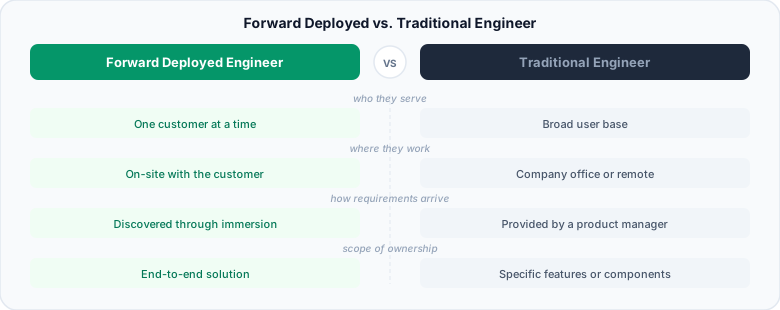
Forward Deployed Engineer vs. Traditional Software Engineer
| Aspect | Forward Deployed Engineer | Traditional Software Engineer |
|---|---|---|
| Focus | One customer at a time | Broad user base |
| Location | Often on-site with customers | Company office/remote |
| Requirements | Discovered through immersion | Provided by product team |
| Scope | End-to-end solutions | Specific features/components |
| Customer contact | Constant, direct | Rare or indirect |
| Travel | Potentially significant | Typically none |
Traditional engineers think: “How do I build this feature well?” FDEs think: “What does this customer actually need, and how do I solve it completely?” FDEs operate more like internal startup founders: owning a problem end-to-end and doing whatever it takes to solve it, rather than building assigned features within defined boundaries.
Forward Deployed Engineer vs. Solutions Engineer
There’s often confusion between FDEs and Solutions Engineers (SEs). Here’s how they differ:
| Aspect | Forward Deployed Engineer | Solutions Engineer |
|---|---|---|
| Primary activity | Building production software | Pre-sales demos and POCs |
| When engaged | Post-sale implementation | Pre-sale and onboarding |
| Coding intensity | High (most of their time) | Moderate (demos, POCs) |
| Customer ownership | Ongoing relationship | Hands off after sale |
Solutions Engineers help sell the product. Forward Deployed Engineers help implement it at depth. Some companies combine these roles, but at FDE-heavy organizations like Palantir, they’re distinct tracks.
Forward Deployed Engineer Skills and Requirements
Strong software engineering fundamentals are the baseline: data structures, distributed systems, API design, database modeling, and fluency in at least one major language. Data engineering matters more than most FDE job descriptions admit — ETL pipelines, data warehousing, and SQL come up constantly in enterprise environments. Cloud platform experience (AWS, GCP, Azure) is effectively required. ML/AI familiarity is increasingly useful as more customers want to embed intelligence into their workflows.
But the technical bar is only half of it. The skills that separate effective FDEs from technically competent ones are almost entirely non-technical. Can you discover what a customer actually needs, rather than what they say they need? Can you explain a technical decision clearly to a VP who doesn’t write code? Can you manage a complex engagement without someone handing you a project plan? These matter as much as the code, arguably more, because they’re harder to develop on the job.
The most effective FDEs are T-shaped: broad enough to pick up new technologies quickly as they move between customers and domains, deep enough to go all the way down when a problem demands it. Rigid specialization works against you in a role where every engagement is different.
Forward Deployed Engineer Salary and Compensation
FDE compensation is generally competitive with or higher than traditional software engineering roles, reflecting the additional skills required.
Base Salary Ranges
The ranges below reflect US market rates. Western European markets typically run 20–30% lower; Eastern Europe, Latin America, and India can be 40–60% lower for equivalent experience levels.
| Experience Level | Base Salary (US) |
|---|---|
| Entry-level FDE | $120,000–$160,000 |
| Mid-level FDE (2–5 years) | $160,000–$220,000 |
| Senior FDE (5+ years) | $200,000–$280,000 |
| Lead/Staff FDE | $250,000–$350,000+ |
When including equity, bonuses, and benefits, total compensation can be significantly higher. At Palantir, total comp for mid-level FDEs typically reaches $250,000–$350,000. At well-funded startups, equity can substantially increase the total picture, and some roles include travel stipends and per diems depending on on-site requirements.
FDE compensation typically runs 10–20% higher than equivalent traditional engineering roles. The role requires broader skills, the travel and customer-facing demands are real, and effective FDEs are harder to find than engineers who build from internal specs. The impact on revenue is also more direct and measurable.
At earlier-stage startups, FDE roles typically come with a lower base ($100,000–$150,000), meaningful equity (0.1–0.5%+), and the chance to shape the customer success function from the ground up.
The FDE Career Path
The typical track runs from Junior FDE (supporting senior colleagues on simpler implementations) to FDE (owning engagements independently) to Senior FDE (leading major accounts) to Lead or Manager, and eventually Director of Forward Deployment overseeing the whole function.
FDE experience also opens strong lateral moves. Many transition into product management, where their customer depth is a significant asset. Others move back into engineering leadership with unusually strong product intuition. Some find the path leads naturally toward founding a B2B company: they understand customer problems better than almost anyone.
Is the FDE Path Right for You?
If you like owning problems end-to-end, enjoy seeing direct impact from your work, and find variety energizing rather than exhausting, the FDE path tends to be deeply satisfying. You’re essentially an internal startup founder on each engagement: figuring out the problem, designing the solution, building it, shipping it, and living with the consequences. The breadth of industries, problems, and technical challenges is rare in engineering careers.
If you prefer deep specialization in one technical domain, find context-switching draining, or want the comfort of being told what to build rather than discovering it yourself, it’s probably not the right fit. The role also selects hard for comfort with ambiguity and customer-facing communication — skills that not every engineer wants to develop, and neither orientation is wrong.
On travel: historically the role required significant on-site time. That has shifted. Many customers now accept remote FDE work, and some companies offer regional roles focused on a specific geography. Expectations vary widely by company, so always clarify before accepting an offer.
Should Your Company Hire Forward Deployed Engineers?
The model makes sense when your product requires significant customization per customer, your buyers are enterprises with complex environments, and implementation quality directly affects whether they renew. If a standard onboarding process leaves customers underdeployed (using a fraction of what the platform can actually do), dedicated engineering at the implementation layer often fixes that. Deal sizes need to justify the cost; this isn’t the right model for high-volume, low-touch sales.
The FDE model works best when your platform is flexible enough to support customer-specific solutions and when long-term customer relationships matter more than one-time conversions. Start with your best engineers who can also communicate clearly. Pair them tightly with product so field learnings flow back. Define scope from the start. Without it, FDEs drift into general-purpose consulting, which helps no one. Measure customer retention, expansion revenue, and time-to-value to demonstrate the model’s impact.
The Forward Deployed Engineer role isn’t for everyone, but for the right person it offers variety, impact, and career growth that most engineering tracks can’t match. If you’re exploring other early-stage technical roles, see our guides on founding engineers and the founding engineer vs CTO comparison.
Building an enterprise product and need technical leadership? Get matched with experienced CTOs and engineering leaders who can help you scale your customer implementation function.