Most fractional CTOs come from traditional software backgrounds. They know how to build web apps, manage engineering teams, and navigate Series A diligence. What they often don’t know is how to evaluate LLM infrastructure, set up an AI evaluation pipeline, or explain to investors why your model strategy is defensible.
For AI startups, that gap matters. The technical decisions are different. The investor questions are different. The risks are different.
Here’s what to look for when hiring a fractional CTO for an AI company, and when the standard fractional CTO playbook applies versus where it falls short.
What’s Different About AI Startups
Most startups have technology as the vehicle. AI startups often have technology as the product. Your model quality, inference speed, evaluation methodology, and data pipeline are not just implementation details: they’re what you’re selling.
That changes what your CTO needs to know. A fractional CTO advising an AI startup should be able to speak credibly about:
- Model selection and trade-offs (build vs. fine-tune vs. prompt engineering vs. RAG)
- LLM infrastructure: latency, cost at scale, context window limits
- AI evaluation: how you measure whether the model is working, and how you catch regressions
- Data strategy: what data you need, how you’re labeling it, what rights you have to use it
- The AI safety and reliability questions investors will ask
If they can’t hold a technical conversation on these topics, they can’t help you with the most consequential decisions your company will face.
What a Good AI Fractional CTO Does
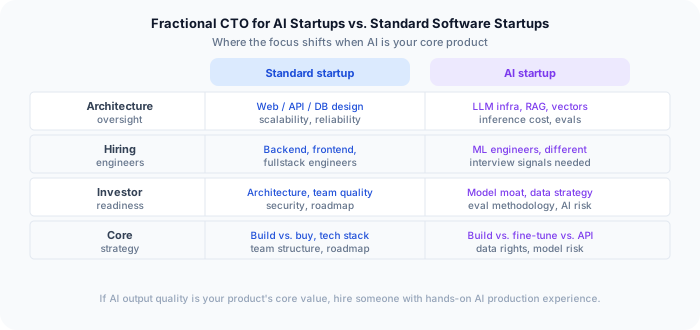
The core responsibilities overlap with any fractional CTO: strategy, architecture oversight, hiring, investor prep. But the focus areas shift.
Model strategy. For most AI startups, this is the highest-leverage decision. Are you calling an API or running your own model? What’s the trade-off between cost and control? What happens to your business if your model provider raises prices or deprecates an API? A good AI fractional CTO has a strong point of view on these questions, not just a framework for thinking about them.
AI-specific architecture. Retrieval-augmented generation, vector databases, fine-tuning pipelines, prompt management, output evaluation. These are engineering decisions with serious cost and quality implications. Someone who has built these systems before can save you months of mistakes.
Investor readiness for AI. Investors at Series A and beyond ask hard questions about AI companies: what’s your moat, how do you evaluate model quality, what’s your data strategy, how defensible is this as frontier models improve? A fractional CTO with AI experience helps you develop credible answers before you’re in the room.
Hiring AI engineers. Evaluating an ML engineer is not the same as evaluating a backend engineer. The signal in a technical interview is different. The role definition is harder. Someone who has hired AI engineers before can reduce your miss rate. For the full hiring process — what skills to screen for, how to evaluate without a technical background, and where to find candidates — see how to hire an AI engineer.
When a Standard Fractional CTO Is Enough
Not every AI startup needs an AI-specialist fractional CTO. If you’re building with off-the-shelf LLM APIs and the AI is a feature rather than the core of your product, a strong generalist fractional CTO can handle most of your needs.
The test: how central is model quality to your value proposition? If you’re a CRM that added an AI summary feature, a generalist will do fine. If the quality of your AI output is why customers pay you, you need someone who understands what drives that quality.
A generalist can also work alongside an AI-specific technical advisor. Some founders split it: a fractional CTO for overall leadership, an AI advisor for model strategy. Just be clear on who owns which decisions and make sure they’re not contradicting each other.
The Right Background
When screening fractional CTOs for AI startup roles, here’s what to look for:
| What to ask | What you want to hear |
|---|---|
| Tell me about an AI product you’ve built or led | Specific decisions, trade-offs, outcomes, not generic commentary |
| How do you evaluate whether an LLM feature is working? | A concrete answer about evals, metrics, or A/B testing, not “it depends” |
| What’s your take on build vs. buy for models? | A nuanced view tied to stage, cost, and moat, not a dogmatic position |
| How would you explain our AI strategy to a Series A investor? | They should be able to draft an answer in the room |
| What AI tools are you using right now? | They should be current and curious, not frozen at a year-old knowledge base |
Stage experience still matters. Someone who only knows enterprise AI will struggle with the pace of an early-stage AI startup. Someone who only knows pure research won’t translate well to a product-focused company. Look for people who have been close to production AI systems at companies similar to yours.
What It Costs
AI-specialist fractional CTOs typically charge a premium over generalists. The market is tighter: fewer people have the combination of AI depth and executive experience.
| Engagement level | Monthly cost (US) |
|---|---|
| Advisory (5 hrs/week) | $5,000–$8,000 |
| Active oversight (10 hrs/week) | $8,000–$15,000 |
| Full fractional (20 hrs/week) | $15,000–$25,000 |
For a full breakdown of what drives fractional CTO pricing, see fractional CTO cost.
The premium is usually worth it if AI is central to your product. A generalist who doesn’t understand your core technical decisions is not a cost saving: it’s a risk.
The Bigger Picture
AI startup technical leadership is still new enough that the playbook is being written. The fractional CTOs who are doing this well tend to share a few things: they’re actively building with AI tools themselves, they have opinions grounded in experience rather than read-only knowledge, and they’re honest about what they don’t know. That last one is more important than it sounds. The AI space changes fast enough that confidence without humility is usually a warning sign, not a credential.
For a broader overview of what the fractional CTO role covers, see the fractional CTO guide. For questions about what this leadership looks like at different stages, see when to hire a CTO.
Building an AI startup and not sure what kind of technical leadership you need? Tell us about your company and we’ll help you figure out the right fit.