Most startup founders who say they need an AI engineer need something more specific: someone who can take a working product and add a capability — a chatbot that knows your data, a voice agent that handles inbound calls, a recommendation engine, an automation that replaces a manual process. What they don’t need is a PhD researcher who wants to train models from scratch.
The confusion between these two things is where most bad AI hires happen.
AI Engineer vs. ML Engineer vs. Data Scientist
The terms get used interchangeably. They shouldn’t be.
A data scientist analyzes existing data to surface insights. They use Python, SQL, and statistical methods. Most of their output is reports and models in notebooks, not production software. If you need to understand your user behavior or build internal dashboards, this is who you hire.
An ML engineer builds the infrastructure to train, deploy, and monitor machine learning models at scale. They care about data pipelines, model performance, and production reliability. Most startups don’t need one until they’re training proprietary models on significant data.
An AI engineer builds products and features powered by AI — primarily by integrating existing models (frontier models from OpenAI, Anthropic, and Google, speech APIs like Whisper and ElevenLabs) rather than training new ones. They write production software, design prompts, build retrieval systems, and make the trade-offs between cost, latency, and quality that determine whether an AI feature works in production.
If you’re building a startup product with AI capabilities, an AI engineer is almost always what you need. If someone calls themselves an ML engineer and quotes you a project involving custom model training, that’s a signal to clarify scope.
What a Good AI Engineer Knows
Technical depth matters, but the specific shape of it matters more. An AI engineer who was excellent in 2022 may be behind if they stopped learning. The field moves every few months and what was best practice a year ago is often overkill or obsolete.
The core skills:
Fluency with the major model APIs — OpenAI, Anthropic, Google Gemini — and the ability to reason about which model fits which task based on cost, latency, and capability. An AI engineer who has only ever used one provider is a yellow flag.
Understanding of retrieval-augmented generation (RAG): how to connect a model to your own data so it can answer questions about your product, documents, or customers without hallucinating. This is the most common AI feature startups need and the one where inexperience shows fastest.
Prompt engineering — not as a parlor trick, but as a systematic practice. Good AI engineers version their prompts, run evals against test cases, and treat prompts like code. Bad ones write a prompt once and call it done.
Cost and latency awareness. Every AI feature involves a trade-off: faster and cheaper, or slower and better. A good AI engineer can articulate those trade-offs and make the right call for your specific use case. If they can’t tell you what a thousand API calls will cost, they’re not thinking about production.
Evaluation. This is the skill that separates production-ready AI engineers from hobbyists. How do you know if the AI is giving good answers? What’s your error rate? How do you catch regressions when you update a prompt or switch models? Candidates who haven’t thought about this have never shipped AI to users at scale.
What you’re not looking for:
Research publications, experience training large models from scratch, or deep expertise in model architectures. That’s ML research. Unless you’re building a foundational model company, it’s not what you need.
How to Evaluate Them Without a Technical Background
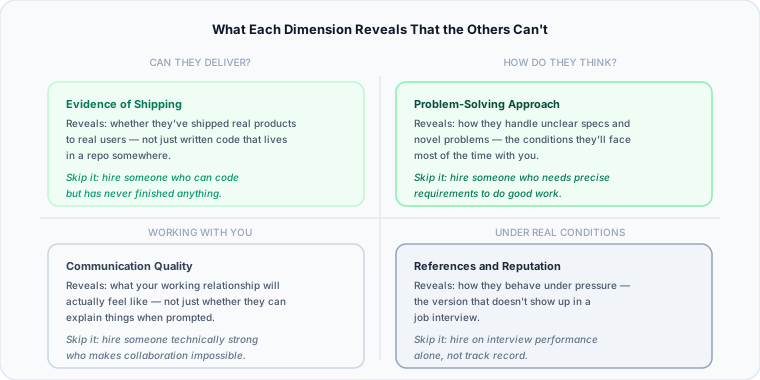
You can’t read their code. You can evaluate whether they think like someone who has shipped AI products.
The end-to-end walkthrough. Ask them to describe an AI feature they built from start to finish: what the product needed to do, how they approached it technically, what went wrong, and what they’d do differently. What you’re listening for: do they talk about failure modes, evaluation, and iteration, or do they describe a clean success story with no complications? AI projects always have complications.
The “what broke” question. Ask specifically: what’s the hardest failure you’ve dealt with in an AI system, and how did you diagnose it? Hallucinations, latency spikes, prompt injection, cost overruns, model deprecations — experienced AI engineers have stories here. Someone who hasn’t hit these problems hasn’t shipped to production at any meaningful scale.
The trade-off question. Give them a hypothetical: a user-facing chatbot needs to respond in under two seconds and stay under $0.01 per query. How do they think about it? You’re not looking for the right answer. You’re looking for structured reasoning about constraints.
The recency check. Ask what they’ve been building or learning in the last three months. AI moves fast enough that someone who stopped paying attention a year ago is behind in ways that will affect your project. Curiosity and continuous learning are load-bearing traits in this field.
If you have access to a technical advisor or fractional CTO, have them run a technical screen. Paid trial projects — building a small proof of concept on your actual stack — reveal more than any interview. If you’re also thinking about the technical leadership layer above the engineering hire, fractional CTO for AI startups covers that question directly.
Where to Find AI Engineers
The AI engineering community is concentrated in a few places.
Twitter/X remains the most active place for AI engineers to share work and signal availability. Searching for people who post about LLMs, RAG, and AI products (not just reposting AI news) surfaces active practitioners.
GitHub tells you more than a resume. Look at what they’ve built and committed. Public projects using the tools you need — LangChain, LlamaIndex, vector databases, model APIs — show direct engagement with the work.
AI-specific communities: the LangChain Discord, Hugging Face forums, and various AI builder Slack groups are where practitioners talk shop. Posting a clear role description in these communities often reaches people who aren’t actively job searching but would consider the right project.
Referrals from other founders building AI products are the highest-signal channel. Someone who has already been evaluated in a similar context and delivered is worth more than any cold candidate with an impressive resume.
We also match founders with vetted AI engineers through FCTO — the same process as fractional CTOs, applied to hands-on AI builders.
What AI Engineers Cost
AI engineers command a meaningful premium over general software engineers, reflecting the scarcity of people who combine strong engineering fundamentals with current AI tooling experience.
| Experience Level | US Annual Salary |
|---|---|
| Junior (0–2 years AI-specific) | $110,000–$160,000 |
| Mid-level (2–4 years) | $155,000–$220,000 |
| Senior (4+ years) | $200,000–$310,000 |
| Staff / Lead | $280,000–$350,000+ |
For contract and fractional arrangements: $75–$300/hour depending on seniority and specialization. Fixed-price project work for a well-scoped AI feature typically runs $15,000–$60,000.
Remote AI engineers in Western Europe typically run 20–30% lower than US rates. Eastern Europe runs about 40–50% lower, with the timezone overlap a practical advantage for async collaboration. India, Southeast Asia, and Latin America run 50–70% lower. The remote-first nature of AI engineering work makes global hiring more viable here than in most disciplines.
For a first hire at the seed stage, most startups land in the $150,000–$180,000 range for a mid-level AI engineer with 2–3 years of relevant experience — below market in exchange for equity, but the US median is around $160K, so the discount is modest. Equity typically runs 0.3–1% for a first or second technical hire depending on your stage and valuation.
Red Flags Worth Knowing
They talk about AI in general terms, not specific trade-offs. Phrases like “we’ll use the latest models” and “AI will handle that” without specifics about which model, at what cost, with what evaluation strategy are signs of someone who has read about AI more than they’ve built with it.
They propose training a custom model for a problem that doesn’t need one. Most startup AI problems are solvable with existing models and good prompt engineering. If someone immediately reaches for custom training, ask why. The answer should involve a specific capability gap that existing models can’t fill.
They’ve never had a production AI feature fail. Not a boast — a warning sign. AI features fail in production in specific, predictable ways: hallucinations that users notice, latency that kills UX, costs that spike unexpectedly, prompts that break when the model is updated. Someone who hasn’t hit these hasn’t shipped at scale.
They can’t explain their evaluation approach. If the answer is “we test it manually” or “users would tell us,” that’s not a system. That’s hoping.
The Pace Problem
Hiring a great AI engineer today means hiring someone who will still be great in 18 months, when the tools look different. The field moves fast enough that specific tool expertise matters less than the ability to learn and adapt.
What ages well: strong software engineering fundamentals, clear thinking about trade-offs, experience diagnosing production failures, and a habit of building and shipping rather than following trends.
What ages poorly: deep specialization in a single framework, strong opinions about specific models over others, or an identity built around a particular approach that may be obsolete by the time your product ships.
Hire for the thinking, not the current tool set.
Looking for a vetted AI engineer for your startup? Tell us what you’re building and we’ll match you with the right person within 24 hours.