You have a CTO, or you’re about to hire one. Either way, you’re probably wondering the same thing most non-technical founders wonder: what does a CTO actually do all day?
It’s a fair question, and not knowing the answer is genuinely risky. If you don’t understand what your Chief Technology Officer’s day looks like, you can’t tell whether they’re performing, whether they’re overloaded, whether they’re spending time on the right things, or whether the role even fits your current stage.
The honest answer: it depends almost entirely on what stage your company is at.
Why Stage Matters So Much
The four core responsibilities stay constant throughout:
- Technology strategy: Setting the direction for how technology serves the business
- Architecture and technical quality: Ensuring systems are built soundly and can scale
- Engineering team: Hiring, developing, and retaining technical talent
- Execution: Ensuring the engineering team delivers
What changes at each stage is how much time goes to each, and what those things look like in practice on a Tuesday afternoon.
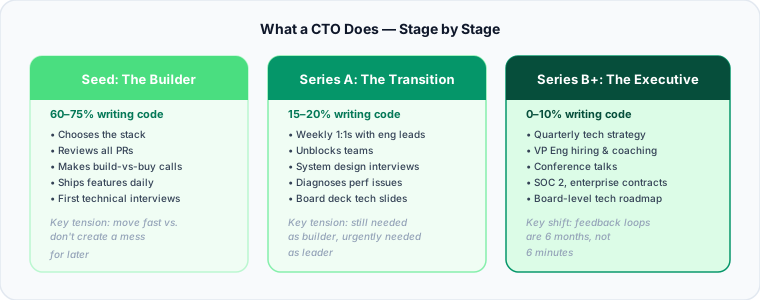
Stage 1: Pre-Seed to Seed (The Builder)
At this stage, your CTO is primarily a builder. If you have a technical co-founder, this is them. If you’ve hired your first technical lead, this is them too.
The most important thing to understand: they should be writing code most of the day. If your seed-stage CTO is spending the majority of their time in meetings, on calls, or in strategic planning sessions, that’s a problem. The tension they’re managing every day is move fast now vs. don’t create a disaster for later. When they push back on a timeline, ask why, listen to the answer, then respect it.
Monday: You and your CTO sit down for 20 minutes to run through the week’s priorities. There’s an investor meeting Thursday. Which features need to be live by then? The CTO pushes back on one item: the notifications feature will take three days, not one. You reprioritize together. Then they’re building. The authentication flow has an edge case that’s been breaking on mobile. They find it, fix it, write a test so it can’t regress.
Tuesday: More building. A contractor submitted a pull request over the weekend. The CTO reviews it. The code works, but it’s not structured the way the rest of the codebase is. They leave comments, hop on a 15-minute call to explain why it matters, and merge a revised version.
Wednesday: A 45-minute call with a potential engineering hire. The CTO looks at their GitHub before the call. The portfolio is solid. On the call, they ask about how the candidate handled a specific technical tradeoff in a past project. Not a fit, but a useful signal about what to look for next time.
Thursday: Architecture decision day. You’re adding a payment feature. Do you build it yourself or use Stripe? The CTO spends two hours researching, another hour testing Stripe’s API, makes the call: Stripe. Spends the afternoon integrating it.
Friday: Deploy. Write up a quick doc on how the payment integration works and what the edge cases are. Send you an email summary of what shipped this week and what’s left for next week.
If you’re pre-seed and not yet ready for a full-time CTO, a founding engineer can cover most of what a seed-stage CTO does, at a lower cost and with more hands-on commitment.
Stage 2: Series A (The Transition)
This is the hardest period of a CTO’s career, and it’s worth understanding why.
The team has grown to 10–30 engineers. The CTO can no longer write all the code. There’s simply too much of it. But they also can’t fully step back from technical decisions. The team isn’t experienced enough to make them alone yet. They’re caught between two modes: still needed as a builder, but urgently needed as a leader.
Most CTOs who fail do so during this transition. Not because they’re bad at either job, but because moving from one to the other is genuinely hard. As a founder, the best thing you can do is protect their time: every meeting you pull them into has a real cost, and uninterrupted blocks are how they stay effective at both. If you’re not yet doing enough CTO-level work to justify a full-time hire, a fractional CTO can cover the strategic side while your team handles delivery.
Monday: Leadership team meeting. The head of product wants to add three features to this sprint. The CTO explains that two of them require backend work that the team is already at capacity on. They negotiate: one feature now, two next sprint. After the meeting, the CTO writes up the decision so the engineering team has context.
Tuesday: Three back-to-back 1:1s with engineering leads. One lead is frustrated: a dependency on another team keeps blocking their work. The CTO listens, asks questions, and commits to resolving the blocker by end of week. Another lead is doing well but needs guidance on how to handle an underperforming engineer on their team. The CTO coaches them through the conversation they need to have. Then back to the code: a complex integration with a third-party data provider that requires the CTO’s depth. Four hours of focused building.
Wednesday: Interview loop for a senior backend engineer. The CTO runs the system design round. The candidate is technically strong but has never worked in a fast-moving startup. The CTO gives a provisional yes with a flag for the recruiter.
Thursday: Performance issue escalated by the team. The app is slow at 10x original load. Something that wasn’t a problem at seed. The CTO pulls up the metrics, runs some queries, identifies the bottleneck: a database query that’s running without proper indexing. Leads a 90-minute architecture session with two senior engineers. They leave with a plan.
Friday: Board deck prep. The CTO needs to produce three slides: current architecture overview, technical roadmap for the next two quarters, and status of the security improvements the board asked about last quarter. Spends the morning on it. Afternoon: 1:1 with you. Flags a team tension: two senior engineers have conflicting approaches to how the API should be structured. Asks for your read before they make the call.
Stage 3: Series B and Beyond (The Executive)
By Series B, the CTO is a full executive. The product has been built. The team has leaders. The CTO’s job is now to set direction, develop the organization, and represent technology externally.
Many CTOs struggle here because the feedback loops are longer. At seed, you ship code and know immediately if it works. At Series B, you make an organizational decision and won’t know if it was right for six months. The output is also harder to see as a founder. There’s no code with their name on it. The right thing to evaluate is the quality of the people and teams they’ve built around them.
Monday: Quarterly planning session with product and engineering leadership. The CTO presents a proposed technology investment for the quarter: migrating a core service to a new architecture that will unblock three product initiatives. There’s pushback on the timeline. Product wants the features, not the infrastructure work. The CTO holds the line, explains the downstream cost of not doing it, and gets alignment by end of the session.
Tuesday: Three interviews for VP of Engineering. The CTO is building the management layer beneath them. Between interviews, they review a post-mortem from a production incident last week. The team handled it well. The CTO annotates the doc with one structural change they want made to the on-call rotation.
Wednesday: A developer conference. The CTO’s talk, How we scaled our data pipeline from 10K to 10M events per day, draws a full room. Three senior engineers introduce themselves after. One follows up on LinkedIn that evening. The CTO files the name for a role opening in Q2.
Thursday: Call with legal and security about SOC 2 certification, a requirement for the enterprise contracts in the pipeline. The CTO signs off on the remediation plan. Then a 90-minute working session with the VP of Engineering on the engineering career ladder. They’re updating it to reflect the new senior staff engineer track. Three engineers are ready for promotion; the CTO reviews the cases.
Friday: Board meeting prep. The CTO is presenting the technology roadmap, engineering headcount plan for the next two quarters, and an update on technical debt remediation. They spend the morning getting it right. This is not a summary, it’s a strategic document. In the afternoon, a 1:1 with the VP of Engineering. One team is struggling with morale after a reorg. They discuss whether to address it in the all-hands or directly with the team lead.
How the Role Changes: A Stage-by-Stage Snapshot
| Activity | Pre-Seed / Seed | Series A | Series B+ |
|---|---|---|---|
| Writing code | 60–75% | 15–20% | 0–10% |
| Architecture & technical decisions | 10–15% | 20–25% | 10–15% |
| People management & 1:1s | 0–5% | 25–30% | 35–40% |
| Recruiting & interviews | 5–10% | 20% | 10–15% |
| Strategy & planning | ~5% | 10–15% | 20–25% |
| Investor & board communication | 5–10% | 5–10% | 15–20% |
The One Thing Every CTO Does at Every Stage: Translate
Regardless of stage, the most underestimated part of a CTO’s job is translation.
Your investors don’t understand what “we need to refactor the authentication layer” means. Your board doesn’t know why a database migration takes three weeks. Your sales team doesn’t know why the integration a customer is asking for isn’t a “quick add.”
Every day, the CTO bridges that gap between technical reality and business language.
What translation looks like:
To the CEO: “The new feature has a 70% chance of shipping this sprint. The 30% risk is a third-party API that’s been unreliable. If it slips, here’s our plan.”
To the board: “We’re rebuilding the data pipeline. It takes 6 weeks of engineering time, but it means we can onboard enterprise customers 3x faster, which directly unblocks the Q3 revenue target.”
To investors in due diligence: “Our architecture can handle 50x current load without significant re-engineering. Here’s specifically how.”
Thinking about hiring one? See our CTO job description guide for what to put in the spec, and fractional CTO vs. full-time to figure out which model fits your stage.
Not sure what kind of technical leadership your startup needs right now? Tell us where you’re at and we’ll help you figure out the right fit.