You can’t read their code. That’s a real constraint, but it’s less limiting than it seems. The qualities that predict whether a developer will actually work out (judgment, communication, the ability to ship things that aren’t perfectly specified) are visible to anyone paying close attention. You don’t need to verify every technical claim yourself. You need to know what to look for and how to get the right people to help you look.
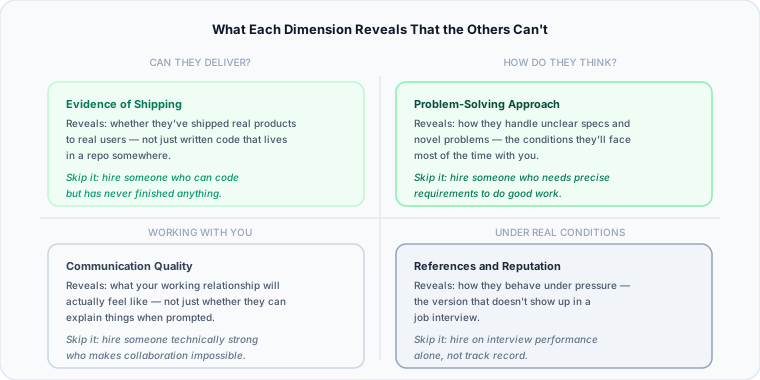
The Non-Technical Evaluation Framework
There are four dimensions you can assess without a technical background: whether they have a track record of shipping, how clearly they communicate, how they approach problems they haven’t seen before, and what people who’ve worked with them actually say. Each tells you something the others don’t.
Dimension 1: Evidence of Shipping
The best predictor of future building is past building. What you’re looking for in a portfolio is evidence of products real users actually use, not just demos or tutorial projects. Complete applications matter more than individual features. Live, working links carry more weight than screenshots. Projects with visible complexity (authentication, database integration, third-party APIs) demonstrate more than something built following a guide.
For each project they show you, ask what it does and who uses it. Ask specifically what part they built, to clarify their actual contribution versus group work. Ask what the hardest problem was: good answers are specific and detailed, not general. Ask what they’d do differently, which tells you whether they reflect on their work or just move on. These questions require no technical background to ask or evaluate.
Watch for vague descriptions (“I worked on the backend”), inability to demonstrate anything they’ve built, group projects where their personal contribution is impossible to pin down, and defensiveness when asked for specifics. A developer who can’t tell you what they built and why can’t explain their work to you when it matters either.
Dimension 2: Communication Quality
A developer who can’t explain their work to you will be a constant source of friction regardless of their coding ability. You are their primary stakeholder. That relationship needs to work.
Test this directly. Ask them to explain something technical in plain terms: how would they explain APIs to a non-technical person, or why a web application might run slowly. What you’re listening for is whether they use analogies and everyday language, check your understanding as they go, and adjust their explanation when it’s not landing. The opposite (drowning you in jargon, assuming knowledge you don’t have, getting impatient when you don’t follow) is showing you exactly what collaboration with them will feel like.
Give them a vague requirement: “We need to build a feature that lets users collaborate.” A good answer starts with questions: what kind of collaboration? Real-time or async? What actions are users taking? A developer who immediately starts describing their solution without asking anything is showing you how they’ll handle unclear requirements, which is what you’ll be giving them most of the time.
Also review their written communication. Are emails clear and organized? Do they respond to questions directly or tangentially? For remote work especially, written communication isn’t a secondary skill: it’s where most of the actual work happens.
Dimension 3: Problem-Solving Approach
You can’t evaluate whether the technical solution is optimal. You can evaluate how they think through a problem, and that often predicts the former.
Present a concrete scenario: “Imagine we’re building a marketplace app. Users report it’s very slow when there are many listings. Walk me through how you’d approach diagnosing and fixing this.” You don’t need to understand the technical answer. You’re listening for whether they ask questions before proposing solutions (“what do you mean by slow? What operations are users doing?”), whether they consider multiple possible causes rather than jumping to one, whether they acknowledge tradeoffs, and whether they can explain their reasoning to you in plain language. A developer who jumps straight to a solution, won’t acknowledge that other approaches exist, or can’t explain their thinking clearly is showing you how they’ll work with you.
Test ambiguity tolerance separately. Tell them a user said “the app doesn’t work” and ask how they’d respond. A good developer asks clarifying questions (what browser, what were they doing, what error did they see) then works systematically from there. A developer who assumes they already know the problem, or who blames the user, is going to be difficult to work with when requirements are unclear, which is most of the time in an early-stage company.
Dimension 4: References and Reputation
References are your most reliable evaluation tool and the one most often rushed. Call at least two, and ask for previous managers or technical leads in addition to peers: the people responsible for their work will give you a different read than the people who liked working with them.
Ask specifically about technical work relative to peers (“how would you rate them compared to others you’ve managed?”), how they handled unclear or changing requirements, whether they were easy to work with day-to-day, how they performed under pressure, and whether the reference would hire them again and for what kind of role. The last question is the most important. A reference that pauses before answering “would you hire them again” is telling you something.
Read the subtext. Enthusiastic, specific praise is a strong signal. Generic praise (“they were a good team member”) is lukewarm. Hesitation or qualification is worth noting. “They’re good, but…” means follow the but wherever it goes. References rarely say directly negative things about former colleagues, but they communicate clearly if you know how to listen.
On online presence: GitHub activity, LinkedIn recommendations, and technical community participation can surface patterns worth noting, but don’t over-index on it. Some excellent developers have minimal public profiles. Complete absence in a technical candidate is mildly unusual, but absence alone isn’t disqualifying.
Getting Technical Help with Evaluation
You don’t have to evaluate alone. If you have a friend, advisor, or paid consultant with a technical background, put them to work: have them review candidate portfolios and code samples, sit in on technical interviews, and give you a clear read on whether the person can actually do the job. You don’t need a full technical opinion on every dimension. You need someone credible enough to tell you when a candidate is bluffing.
If you’re making a critical early hire and want professional-grade evaluation, a fractional CTO takes this further. They can help you define what you actually need before you start looking, screen candidates technically, evaluate past work in context, run technical interviews, and negotiate offers with the kind of market knowledge that keeps you from overpaying for the wrong profile. For a hire that shapes your technical foundation, this is almost always worth the cost.
The most underused evaluation tool is a paid trial project. Rather than trying to assess capability through conversation alone, define a small piece of real work (8 to 20 hours is typical), pay a fair rate ($500 to $2,000 depending on scope), and evaluate what they actually produce. You learn things an interview can’t tell you: whether they deliver working code, how they communicate when they have questions, how their work quality compares to their self-presentation, and whether they hit the deadline they committed to. Make it a real task you actually need done. Give clear requirements, set a realistic deadline, be responsive when questions come up, and have someone technical review the output before you make a decision. A candidate who interviews brilliantly and produces mediocre work has just shown you something important.
Common Evaluation Mistakes
The most common mistake is overweighting traditional coding challenges. Algorithm tests measure how well someone prepared for algorithm tests. They don’t tell you whether a person can ship a complete product, collaborate under ambiguity, or explain their work to you when something breaks in production. A developer who aces a whiteboard problem and then disappears into their headphones for two weeks is a real type. Use paid trial projects and portfolio reviews instead: they test what the job actually requires.
Ignoring communication is the second most common error. A developer who can’t explain their work to you is a constant liability, not just an occasional annoyance. You are the primary stakeholder. If they can’t communicate with you clearly in an interview, that problem doesn’t shrink once they’re hired.
Hiring for credentials instead of fit is another common path to a bad outcome. A background at a large company signals that someone can operate in a large company. It doesn’t signal that they can work with ambiguity, own decisions without a product manager specifying every requirement, or care about the outcome rather than the process. Look for evidence of working in similar environments and a demonstrated ability to self-direct.
Rushing because you feel urgent pressure to hire is the mistake that amplifies all the others. A wrong hire costs more time than a longer search. Taking a few extra weeks to run references properly, complete a paid trial, and think carefully about fit is almost always the right call. How to Hire a Founding Engineer covers the full process, and the Non-Technical Founder’s Guide gives broader context on working with technical people.
Finally: never skip references. They’re your most reliable signal, and they’re the one most often rushed or skipped because everything else went well. Everything else going well is exactly when references matter most.
Need help evaluating technical candidates? Get matched with experienced technical leaders who can help you hire confidently.