You have a specific technical problem. Maybe your app is slow and you don’t know why. Maybe you need to integrate a payment system your team has never touched. Maybe investors are asking questions about your architecture that you can’t answer confidently. You need someone who has solved this exact problem before, but hiring a full-time engineer takes months and an agency feels like handing the keys to a black box.
That’s the gap a software development consultant fills.
What a Consultant Actually Is
A software development consultant is an independent technical expert who works with your company on a project or retainer basis. They’re not an agency with an account manager in between, and they’re not a full-time employee. You’re getting a specific person with specific experience, available for a defined scope of work.
The range is wide. Some consultants are primarily advisors: they review what you’re building, tell you what’s wrong, and hand back a set of recommendations. Others are hands-on implementers who write production code alongside your team. The best ones for early-stage startups do both: they diagnose the situation, design the approach, and either build it or oversee the build closely enough that you know it’s done right.
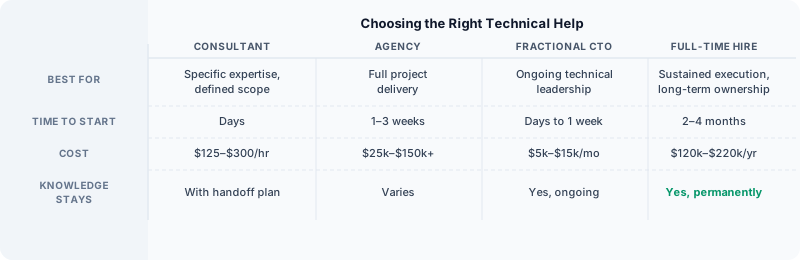
A fractional CTO shares some characteristics with consulting work, but takes on ongoing executive-level technical leadership rather than scoped project work. If what you need is someone to own your technical direction for the next 12 months, that’s a different engagement than hiring a consultant to solve a defined problem.
When a Consultant Is the Right Model
The clearest case is specific expertise you don’t have and can’t afford to acquire. Your team knows how to build web apps but has never implemented real-time infrastructure, complex payment flows, or a machine learning pipeline. Hiring a consultant who has done it ten times is faster and cheaper than having your team figure it out on the fly, and less risky than an agency that may assign whoever is available.
A consultant also makes sense when you need a second opinion before a major commitment. Before choosing a database architecture, designing how your services communicate, or deciding whether to rebuild something from scratch, an outside expert can pressure-test your thinking. That conversation, which might cost you $3,000–$5,000, can prevent an architectural decision that costs six figures to undo 18 months later.
If you’re heading into technical due diligence, a consultant can prepare you: documenting your architecture, cleaning up the most visible code quality issues, and sharpening the technical narrative you’ll present to investors. Founders who show up to due diligence without this preparation often lose deals on technical credibility rather than product quality.
And when a key engineer leaves or a deadline accelerates, a consultant can fill the gap immediately without the three-month hiring cycle. That flexibility is part of what you’re paying for.
When It’s the Wrong Model
Consultants work best when the problem is bounded. If you’re still figuring out what to build, spending $15,000 on a consultant before you have product-market fit is premature. Validate the problem first, then bring in expert help to build the solution efficiently.
If you need someone writing code 40 hours a week on an ongoing basis, a consultant is the wrong model. The per-hour cost is high and the knowledge walks out the door when the engagement ends. A founding engineer who owns the work long-term is a better fit for sustained execution.
Budget is the other constraint. Good consultants at senior levels charge $150–$300 an hour. If that’s out of reach, no-code tools and a more junior hire with lighter oversight may get you further than spreading a small budget thin across a short consulting engagement.
What It Costs
Rates vary significantly by experience and location. The ranges below reflect US market rates. Western Europe typically runs 20–30% lower. Eastern Europe, India, and Latin America can be 40–60% lower for equivalent experience, which is worth considering if the engagement doesn’t require someone embedded in your timezone.
| Experience level | Hourly rate (US) |
|---|---|
| Mid-level (5–10 years) | $125–$200/hour |
| Senior (10–15 years) | $175–$300/hour |
| Principal / specialist | $250–$500+/hour |
Specialist expertise in security, AI/ML, real-time systems, or fintech compliance commands the higher end regardless of years of experience. That said, a two-week architecture review at $500 an hour is still cheaper than spending 18 months building on the wrong foundation.
On engagement structure: hourly billing works for advisory work or small projects where scope is hard to define. Project-based pricing gives you a fixed cost for a defined deliverable. A monthly retainer, typically for 10–20 hours a week, suits ongoing architectural oversight or fractional CTO-style arrangements.
| Engagement type | Typical cost |
|---|---|
| Architecture review | $3,000–$10,000 |
| Security audit | $5,000–$20,000 |
| MVP advisory (2 months, part-time) | $10,000–$30,000 |
| Specific system implementation | $15,000–$60,000 |
| Ongoing retainer (10 hrs/week) | $5,000–$15,000/month |
How to Find and Evaluate One
The best consultants don’t market themselves heavily. Start with your network: other founders who have faced similar technical challenges, your investors, accelerator alumni. A referral from someone who has worked with the consultant on a similar problem is the strongest possible signal. If your network doesn’t surface anyone relevant, platforms like Toptal and Arc.dev vet candidates before listing them.
When you speak with candidates, the most useful signal is whether they ask good questions before offering answers. A consultant who starts recommending solutions before understanding your constraints is telling you something important about how they work. You want someone who surfaces tradeoffs and explains what they don’t know. Relevant portfolio matters more than impressive portfolio: ask for examples of engagements similar to yours in scope and stage, and ask what the outcome was, not just what they built.
Ask every finalist for two references from similar engagements: did they deliver on scope and timeline, how did they handle communication with non-technical stakeholders, and would you hire them again?
Setting the Engagement Up to Work
Before work starts, get alignment in writing on four things: exactly what will be delivered, when each milestone is due, how often you’ll meet and how to reach them between meetings, and who owns the code and all associated accounts when the engagement ends. IP ownership especially: your contract should specify that all work product belongs to you.
The biggest source of consultant disappointments is unclear requirements going in. If you haven’t done it already, read the guide on how to write technical requirements before your first scoping conversation. The quality of what you get back is directly proportional to the clarity of what you ask for.
Plan for knowledge transfer before the engagement ends, not after. Require documentation as a deliverable, ask for a code walkthrough in the final week, and make sure all credentials and repositories are transferred before the engagement closes. A consultant who disappears with institutional knowledge in their head is a risk you can avoid by building handoff into the contract from the start.
One thing worth flagging if you’re facing multiple technical problems at once: the instinct to hire two or three specialists simultaneously often creates more coordination overhead than it solves. A fractional CTO can sequence those engagements, brief each consultant properly, and make sure their work connects rather than conflicts. If what you need is less a scoped project and more someone to own that whole picture, that’s the right conversation to have instead.
Used well, a consultant compresses months of learning into weeks. The key is knowing exactly what problem you’re handing them.
Tell us what you’re trying to solve and we’ll match you with the right person within 24 hours.