At some point someone will tell you that you need an advisor, a consultant, or a mentor. Sometimes all three. It’s advice that sounds sensible until you try to act on it, and then it gets vague fast. What kind? For what? At what cost? And how do you tell the difference between someone who will actually move you forward and someone who will take your equity, offer periodic encouragement, and disappear?
The honest answer is that outside expertise is high-value in specific situations and a waste of money in others. The difference comes down to how bounded your problem is and how much it matters that someone has solved it before.
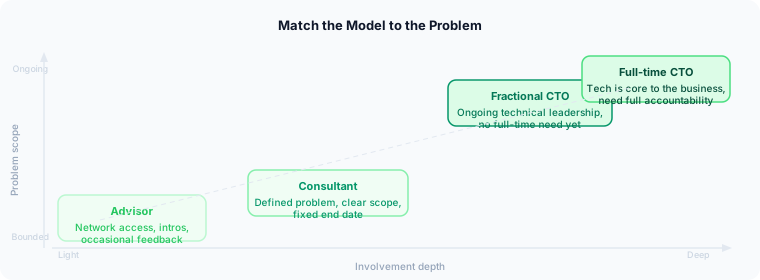
Advisor, Consultant, or Fractional Executive
These terms get used interchangeably, but they describe meaningfully different relationships.
An advisor is a light-touch relationship: a monthly call, occasional introductions, feedback when you ask for it. Compensation is typically small equity, 0.1–0.5%, sometimes nothing at all. The value is access to their network and pattern recognition, not ongoing involvement. Advisors work well for filling a specific knowledge gap or getting introductions you couldn’t get otherwise. They don’t work well for anything that requires deep context about your company.
A software development consultant engages with a defined scope of work: an architecture review, a go-to-market strategy, a pitch deck, a security audit. You’re paying for their time, usually $100–$400 an hour, to solve a specific problem. The engagement ends when the work is done. The value is speed and depth: someone who has made this decision ten times before, available to help you make it once.
A fractional executive takes on ongoing leadership in a function, typically 5–20 hours a week over several months. A fractional CTO is the most common version for product-led startups. They attend your meetings, own decisions, and stay embedded long enough to be accountable for the results. The cost is higher, $5,000–$20,000 a month, but so is the depth of involvement.
When Outside Expertise Is Worth Paying For
The clearest case is a decision you haven’t made before with asymmetric downside. Choosing a cloud architecture, preparing for investor due diligence, entering a new market, pricing your product for the first time: if you get it wrong, the cost to recover is far greater than the cost of good advice upfront. A consultant who has made this call ten times before can compress weeks of your research into a conversation and tell you the two or three things that will actually determine the outcome.
Scaling inflection points also create genuine demand for outside expertise. When your team grows from 5 to 25, when your infrastructure starts breaking under load, when your sales process stops working at higher deal sizes: these are transitions that feel unique to you but are actually well-understood patterns. This is also where technical due diligence often surfaces — investors want to understand whether what’s been built will hold up before writing a cheque. Someone who has navigated them before can save you months of trial and error.
When It Isn’t Worth It
If you’re still figuring out whether customers have the problem you think they have, outside expertise is premature. Consultants are most valuable when the question is clear and the stakes of getting it wrong are high. Before product-market fit, the question is usually still forming. Paying for expert help on solutions before you’ve confirmed the problem is solving in the wrong order.
Watch for the pattern where consulting becomes a way to defer a decision you’re not ready to make. If you find yourself wanting someone to tell you what your strategy should be, the issue probably isn’t a lack of information. It’s a founder confidence problem, and no consultant fixes that. Good outside expertise accelerates your thinking. It doesn’t replace it.
And if the engagement can’t be bounded, be careful. Ongoing consulting relationships that lack defined outcomes tend to drift. You pay for access to someone’s time and gradually stop knowing whether you’re getting value. Retainers make sense when the need is genuinely ongoing and the outcomes are measurable. Otherwise, project-based engagements with clear deliverables are harder to waste.
What It Costs
Advisory relationships are usually equity: 0.1–0.5% with two-year vesting is standard for active advisors. Cash is often nominal or zero. If someone is asking for more than 0.5% for advisory work without a clear ongoing commitment, that’s worth questioning.
For project-based consulting:
| Project type | Typical cost |
|---|---|
| Pitch deck review (2–3 sessions) | $1,500–$5,000 |
| Architecture review | $3,000–$10,000 |
| Go-to-market strategy | $5,000–$20,000 |
| Technical due diligence prep | $5,000–$15,000 |
For retainer engagements:
| Hours per week | Monthly cost |
|---|---|
| 2–5 hours (light advisory) | $2,000–$5,000 |
| 5–10 hours (active consulting) | $5,000–$12,000 |
| 10–20 hours (fractional executive) | $10,000–$20,000+ |
US market rates apply above. Western Europe typically runs 20–30% lower. Eastern Europe, India, and Latin America can be 40–60% lower for equivalent experience.
Finding Someone Who Actually Fits
The best consultants get most of their work through referrals and rarely need to market themselves. Start with founders who have faced a similar problem at a similar stage: your investors, accelerator alumni, domain-specific communities. A referral from someone who hired this person for the same type of work is worth more than any credential.
When you speak with candidates, notice whether they ask questions before offering answers. A consultant who tells you what you need before understanding your situation is not someone who will give you tailored advice. You want someone who surfaces tradeoffs, acknowledges the limits of their knowledge, and makes you feel like you’re thinking more clearly at the end of a conversation, not more reassured.
Look for specific evidence of the outcome you need, not just experience in the general area. “I’ve worked with a lot of B2B SaaS companies” is not the same as “I’ve taken three companies through Series A technical due diligence and here’s what I learned each time.”
References matter. Ask two or three past clients from similar stage engagements: did they deliver on scope and timeline, how did they handle it when things got complicated, and would they hire them again for the same type of work?
Making the Engagement Work
The quality of what you get back is directly proportional to how specifically you define what you need. “Help with our technical strategy” produces generic advice. “We’re deciding whether to rebuild our monolith into services before raising our Series A, and we need someone who has made this call before” produces a useful conversation.
Share the full context. Your runway, your team’s gaps, what you’ve already tried and why it didn’t work. Consultants give better advice with more information, and withholding it doesn’t protect you.
Before work starts, make sure your contract specifies that all work product belongs to you. It’s a standard ask and any reputable consultant will expect it. Plan for what happens after the engagement ends too. If an advisor disappears with institutional knowledge of your company in their head, or a consultant hands back a document you don’t fully understand, you haven’t got value from the engagement. Build knowledge transfer into the agreement from the start.
Outside expertise, used well, compresses the learning curve on decisions that would otherwise cost you months. The key is knowing what you’re hiring for before you start looking.
Tell us what you’re trying to solve and we’ll connect you with the right person.