A non-technical founder built a client dashboard for independent fitness coaches (workout logs, progress tracking, session notes) over a single weekend using Bolt and Cursor. No developer, no agency. She spent the next two weeks on calls with twenty coaches, confirmed six would pay $50/month, and raised a $500K pre-seed off the demo alone. Six months earlier that prototype would have cost $20,000 and eight weeks with a freelancer.
That’s the real shift. AI hasn’t eliminated the need for technical judgment, but it has dramatically lowered the cost of finding out whether your idea is worth building. The danger is assuming that lowered cost extends further than it does.
AI makes it easier to build something. It does not make it easier to build the right thing.
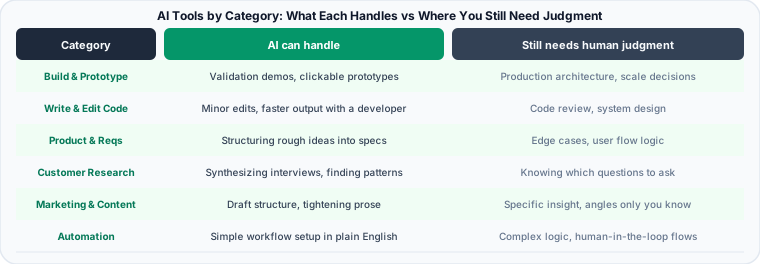
Most tools below have free tiers sufficient for early validation. Paid plans run $20–$50/month per seat.
Build and Prototype
Starting from zero with no developer → Bolt.new. Describe what you want in plain English and it generates a full-stack web app you can share with customers in hours. Not production-ready (the architecture is shallow and there’s no real security model), but real enough to put in front of people and get genuine signal.
Care about UI polish or plan to iterate heavily → Lovable. You describe changes and it updates the app in real time. The output looks closer to something you’d actually ship. Founders use it for internal tools, demos, and lightweight SaaS prototypes where Bolt would feel too rough.
Already have a developer → v0 by Vercel. Describe an interface and it generates React code. Hand that to your developer and skip the design back-and-forth. This is a communication tool more than a build tool.
| Bolt.new | Lovable | v0 | |
|---|---|---|---|
| Best for | Fastest first prototype | Polish + iteration | UI spec for your dev |
| Output | Full-stack web app | Full-stack web app | React component code |
| Works solo? | Yes | Yes | Better with a dev |
| Ceiling | Simple apps only | Simple-to-medium | UI layer only |
All three hit a wall at complex business logic, real-time data, multi-party permissions, or non-trivial payments. Past that point they produce plausible-looking output that doesn’t work. If you’re still hiring an agency for a validation prototype in 2026, you’re overpaying.
Write and Edit Code
Cursor is a code editor built around AI. Your developer writes significantly faster. You can make minor changes (copy, labels, colors) without pulling them in for everything. GitHub Copilot serves the same role for teams on VS Code.
→ If you’re working with a developer, push them to use one of these. If you’re not, these tools won’t replace what you’re missing.
Product and Requirements
Notion AI helps turn rough feature descriptions into structured specs. It doesn’t replace the thinking. You still need to reason through edge cases and user flows. But it closes the gap between “I know what I want” and “I’ve written something a developer can act on.” See our guide to writing technical requirements for the full process.
Linear is the project management tool most engineering teams have converged on. Its AI-assisted issue creation saves time, but the bigger value is visibility: a shared system your developers actually use tells you more than any status update.
Marketing and Content
Perplexity has replaced Google for most founders. It returns cited answers to market, competitor, and technical questions, faster and more useful than search.
Claude and ChatGPT are useful for drafting emails, copy, investor updates, and blog posts. Write your thinking in rough form, use AI to tighten structure and prose, then edit back the specific angles only you know. This is faster than writing from scratch and better than publishing AI output directly.
→ Use Perplexity to research, Claude or ChatGPT to draft, your own judgment to finish.
A Sensible Starting Stack
Non-technical founders don’t want a list of tools. They want a setup. If you’re validating an idea solo in 2026, this is a reasonable default:
- Prototype: Bolt.new (fast) or Lovable (polished)
- Temporary backend: Supabase or Firebase
- Research synthesis: Otter.ai → Dovetail
- Automation: Zapier
- Writing and drafts: Claude
- Project management (once you hire): Linear
This covers most of what you need before you have a developer. When you get one, swap in Cursor and v0.
Where AI Hands the Problem Back
AI tools give confident answers on the following. They’re frequently wrong for your specific situation.
Architecture. Choosing the wrong database early can mean rewriting your entire backend six months in. AI will suggest a reasonable-sounding answer, but it doesn’t know your data access patterns, your growth assumptions, or what you’ll need to add in six months. This is what a fractional CTO provides: someone who has seen that decision play out across many companies.
Security. AI will generate an authentication system that looks correct but allows users to access each other’s data. If you’re handling payments, health records, or anything users expect to be private, a technical review isn’t optional.
Debugging at scale. Isolated errors are manageable. Distributed failures, performance degradation under real load, and subtle data corruption require someone who can reason through the whole system, not just the file in front of them.
Evaluating developers. If you’re hiring to build on top of your AI prototype, you need someone who can assess code quality and engineering judgment. See our guide to evaluating developers.
When You Actually Need a Developer
Most founders delay this decision longer than they should. You likely need a developer when:
- You have paying users and the product is breaking under real usage
- You need custom logic AI tools can’t handle (complex permissions, real-time sync, proprietary algorithms)
- You’re storing sensitive user data (payments, health, PII)
- You’re approaching fundraising and need a codebase that holds up to scrutiny
Before that point, the tools above can get you further than most founders expect. After it, they can’t get you much further at all. Our MVP development guide covers how to scope the transition from prototype to real build.
AI gets you to demo. Judgment gets you to product.
The fitness coach dashboard that raised a pre-seed round was a proof of concept, not a product. What came next was not solvable with Bolt: database design, permissions, billing, the architecture decisions that determine whether the company can scale. That’s not a limitation of the tools. It’s just where the work actually starts.
Not sure what kind of technical support you need at your stage? Tell us about your situation and we’ll help you find the right fit.