CTO as a Service is exactly that: senior technical leadership on demand, without hiring a full-time executive.
The term is used interchangeably with fractional CTO. Both describe the same model: an experienced technology executive working with your company part-time, typically across a few clients at once. The difference is mostly marketing. CTO as a Service tends to come from agencies or structured service providers. Fractional CTO usually refers to an individual working independently. Quality, cost, and fit vary widely either way.
What You Get
A CTO as a Service engagement covers the same work a full-time CTO would own, scaled to the hours you’re paying for.
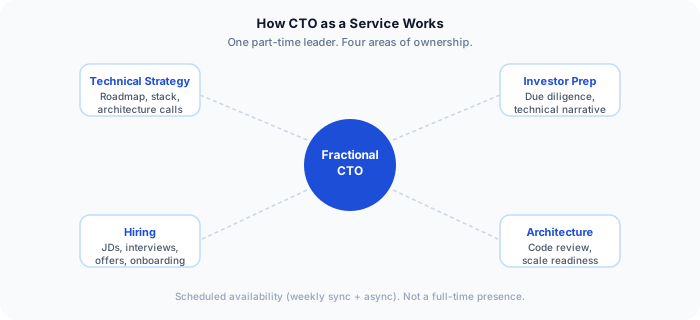
That covers technical strategy: deciding what to build, in what order, on what infrastructure. Architecture oversight: reviewing what your team builds and pushing back early. Hiring: job descriptions, technical interviews, offers. Investor support: your technical narrative, due-diligence prep, fundraising calls.
What it doesn’t cover is full-time availability. A CTO as a Service provider isn’t sitting in Slack all day. They’re available on a schedule, usually a weekly call with async support in between. That’s enough for most early-stage companies.
Individual vs. Agency
Most founders choose between hiring an independent fractional CTO or going with a firm that provides CTO as a Service as a packaged offering.
| Independent fractional CTO | CTO as a Service firm | |
|---|---|---|
| Relationship | One person, deep context | Team, may rotate contacts |
| Continuity | High | Variable |
| Cost | $5,000–$20,000/month | $8,000–$25,000/month |
| Accountability | Direct | Through a firm |
| Flexibility | High | Often packaged tiers |
| Best for | Founders who want a long-term partner | Companies that want a structured service with backfill |
Firms can offer more coverage: if your CTO contact is unavailable, someone else steps in. Individuals build deeper context over time. For most early-stage startups, the depth of an individual relationship matters more than coverage.
When It Makes Sense
CTO as a Service makes sense when you have a technical leadership gap but not enough work or budget to justify a full-time hire.
You’re a non-technical founder. You have developers but no one who can evaluate their work, set direction, or catch problems before they compound. See what it means to be a non-technical founder for more on why this gap gets expensive fast.
You’re approaching fundraising. Series A investors run technical due diligence. A CTO as a Service engagement scoped for fundraising prep (3 to 6 months, focused on your architecture narrative and investor readiness) is a well-defined use of the model.
Your CTO just left. An interim CTO as a Service engagement stabilizes the team, keeps decisions moving, and gives you time to hire a permanent CTO without rushing. Rushed hires at the CTO level are almost always mistakes.
You need the skills but not the headcount. You’re pre-Series A, you’re spending on product, and adding a $300,000 executive to payroll doesn’t fit where you are right now. CTO as a Service solves the skills problem without the budget problem.
When It Doesn’t Make Sense
Your team needs daily leadership. If engineers are blocked on decisions regularly or culture is fraying, scheduled availability isn’t enough.
You need someone to build. CTO as a Service is leadership, not implementation. If you need code written, a founding engineer or a senior developer is the right hire. Many founders confuse the two.
Your engineering team is large. Once you’re past 20 engineers or scaling aggressively, you need a full-time CTO. Part-time leadership starts to show its limits in team morale and decision speed.
For a fuller treatment of where the model breaks down and how to protect yourself when hiring, see risks of hiring a fractional CTO.
What It Costs
Most engagements run $6,000–$15,000 a month for a 10–20 hour week, with advisory-only engagements starting around $3,000 and interim CTO coverage running $18,000–$30,000. The full breakdown — what drives the price, equity expectations, and how fractional compares to full-time — is in the fractional CTO cost guide.
What Good Looks Like
The weekly rhythm should feel like a working relationship, not a status update. You should be making decisions together, not waiting for a summary of what happened last week. If it starts feeling like a reporting structure, something is off.
For a broader view of the fractional CTO model, see the fractional CTO guide. If you’re choosing between fractional and full-time, this comparison lays out the tradeoffs.
Trying to figure out if CTO as a Service fits where you are? Tell us about your startup and we’ll help you find the right model.