A seed-stage founder recently asked us what to offer their first engineer. The candidate had a competing offer from a Series B startup at $185K. The founder had $1.2M in the bank and no product yet. The answer wasn’t just a number: it was a framework for how cash, equity, and timing fit together.
Here’s that framework, with real numbers.
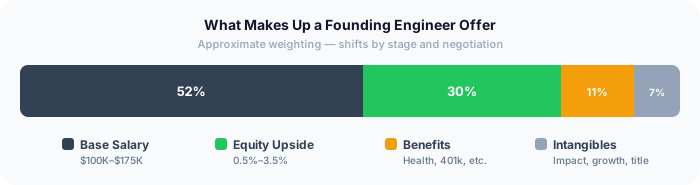
Salary Expectations
Founding engineers typically accept 15–40% below market rate, offset by equity.
Salary Ranges by Stage
| Company Stage | Founding Engineer Salary | Market Rate Comparison |
|---|---|---|
| Pre-seed (no funding) | $80,000 - $130,000 | 40-50% below market |
| Pre-seed (with funding) | $100,000 - $150,000 | 25-40% below market |
| Seed | $120,000 - $160,000 | 15-30% below market |
| Series A | $140,000 - $180,000 | 10-20% below market |
Open to hiring remote? Cash comp drops significantly outside the US: roughly 20–40% in Western Europe (UK ~80%, Germany ~75%), and 50–70% in India, Eastern Europe, and LatAm.
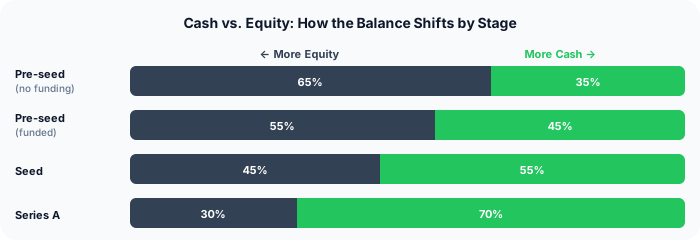
Salary goes up with experience, specialized skills (ML, security), and how well-funded you are. It goes down when stage is earlier, equity is larger, or the engineer is remote in a lower-cost market. The two sides balance each other: more risk taken in cash usually means more equity offered in return.
Equity Expectations
Typical Equity Ranges
| Scenario | Equity Range |
|---|---|
| First engineer, pre-funding | 1.5% - 3.5% |
| First engineer, post-seed | 0.75% - 2.0% |
| First engineer, Series A | 0.5% - 1.0% |
| Second engineer | 40-60% of first engineer’s grant |
| Third+ engineer | 25-50% of first engineer’s grant |
For a practical calculator to model option pools and dilution, Index Ventures’ Option Plan is one of the most useful free tools available.
What Drives Equity Up or Down
Equity goes up when someone joins earlier, takes a lower salary, brings skills you can’t easily find elsewhere, or is leaving a high-paying job to take a real risk. It goes down when they’re joining later, taking closer to market rate, or coming from another startup where they already understand the equity trade-off and aren’t counting on a windfall.
The Equity Cliff
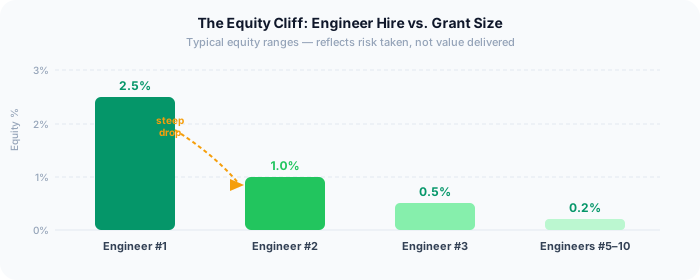
The drop between engineer #1 and #2 is steep and often surprises founders. First engineer: 1.5–3%. Second: 0.5–1.5%. Third: 0.3–0.8%. By engineers 5–10, you’re looking at 0.1–0.5%. That’s not a reflection of how valuable those people are. It’s a reflection of how much risk they’re taking relative to the person who joined when there was nothing.
Structuring the Offer
Standard Vesting Schedule
The industry standard is 4-year vesting with a 1-year cliff: nothing vests until month 12, then 25% all at once, then the remaining 75% monthly over 3 years. If they leave before the cliff, they get nothing. Deviating significantly from this raises questions on both sides.
Single vs. Double Trigger Acceleration
This clause determines what happens to unvested equity if the company gets acquired. Single trigger means equity accelerates on acquisition alone. Double trigger means it only accelerates if the company is acquired and the employee is let go. Most companies use double-trigger or no acceleration. Single-trigger sounds generous but can create awkward incentives: an employee fully vested the moment a deal closes has less reason to stick around through integration.
Strike Price and Exercise Windows
The strike price is what the engineer pays to buy their shares, set at the 409A valuation when the grant is made. The exercise window is how long they have to do that after leaving. The standard is 90 days, which often forces people to exercise early or lose their options entirely, a real financial burden if shares are illiquid. More founder-friendly companies offer 5–10 year windows. It costs you nothing and signals you’re thinking about your people long-term. Worth considering if you want to compete with companies that already offer it.
Sample Offers by Scenario
Pre-seed, no funding yet. You need someone to build the MVP and potentially grow into a CTO. The founders are paying themselves similarly. A reasonable offer here: $100K salary, 3% equity with a standard 4-year cliff, health insurance, and a conversation about moving to 5% if they step into the CTO role. The equity is speculative, and everyone in the room knows it. That’s the deal.
Post-seed, $2M raised. You have money and need your first full-time engineer. Something like $140K salary and 1.5% equity is defensible. The honest math: a market-rate engineer in this role might earn $180K–$220K elsewhere, so the candidate is implicitly leaving $40K–$80K per year on the table. For equity to compensate that over 4 years, you’d need a $2.6M–$5.3M equity outcome just to break even on cash. Worth being upfront about: candidates doing this math will ask.
Series A, $10M raised. You need an experienced technical lead. At this stage, $175K salary, 0.8% equity, and a $20K signing bonus is competitive. Year one cash lands around $195K with the bonus. The equity is smaller because the risk is lower and the company is more real. A professional development budget and full benefits package rounds it out.
Making Your Offer Competitive
A senior engineer at FAANG (or equivalent large tech companies globally) earns $300,000–$500,000+ in total compensation. You won’t win on cash. You compete on everything else.
Frame the equity honestly: “1.5% of a $100M exit is $1.5M” is a real number, but only if the company gets there. Don’t oversell, but don’t undersell either. A good founding engineer understands risk. They’re doing the math too.
Beyond equity, what you’re actually selling is ownership. Direct impact on the product and company direction. A title and scope of responsibility they couldn’t get at a large company for another decade. Learning that compounds fast when you’re wearing every hat. These aren’t soft perks. For the right person, they’re the whole point.
The small things matter too: flexible hours, remote work, equipment budget, choice of tools. They cost you almost nothing and signal that you treat people like adults.
Negotiations
Watch both sides. A candidate who’s only focused on cash and uninterested in equity, or whose salary demands don’t match your stage, usually isn’t the right fit for a founding role. That’s not a judgment. It means they want different things than what a startup can offer. On your side: offering below-market cash with minimal equity isn’t a startup offer, it’s just underpaying someone. Being secretive about your cap table or valuation kills trust before the relationship starts.
If they push for more salary, the options are: shift equity down and cash up, offer a signing bonus instead of a higher base, or be direct about your runway constraints. If you genuinely can’t get close to their minimum, that’s information. It may mean the fit isn’t right for this stage.
If they push for more equity, the levers run the other way: lower the salary, add milestone grants tied to company achievements, or open a conversation about a CTO-track path with more upside. Be clear about what dilution looks like over time so there are no surprises later.
Good founding engineers will ask about refresher grants. Be open about your philosophy rather than deflecting. If they say they’re leaving a lot of money on the table, validate it. They are. Then quantify the equity opportunity honestly and acknowledge that the startup path isn’t right for everyone. If they need to be talked into the risk, pay attention to that.
The right founding engineer knows what they’re signing up for. Your job is to make sure the offer reflects that honestly: fair cash for the stage, real equity with standard terms, and a clear picture of what they’re building toward.
For the full context on the role, read our Founding Engineer guide and How to Hire a Founding Engineer. If you’re still deciding between a founding engineer and a CTO, see our comparison guide.
Ready to make an offer but want guidance? Get matched with experienced startup advisors who can help you structure competitive compensation.