A startup founder hires a development agency after seeing strong reviews online. The first two milestones go well. By milestone four, the team has turned over twice, the codebase is undocumented, and the features delivered don’t hold up under real load. Six months and $60,000 later, they’re starting over with a different team. The problem wasn’t offshore development. It was the absence of technical oversight on their end and a contract that gave them no leverage when things went wrong.
The cost advantage is real: depending on region and seniority, offshore development runs 40-70% less than US-based equivalents. That gap is worth pursuing if you pursue it correctly. This guide covers how.
Where Teams Are Located
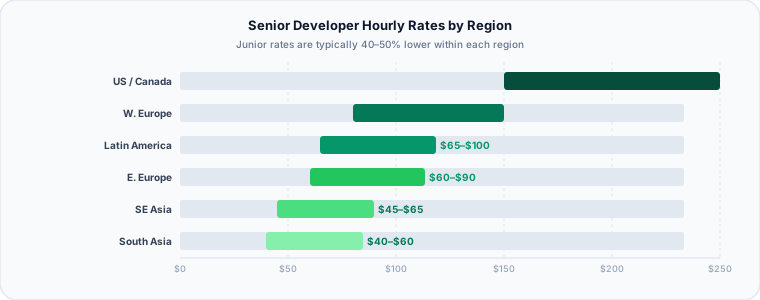
Eastern Europe (Poland, Ukraine, Romania) offers close time zone overlap with US companies on East Coast hours, a strong technical education tradition, and mid-range pricing. Senior developers typically run $60-$90 per hour. Cultural familiarity with Western business norms makes communication easier than the pricing gap might suggest.
South Asia (India, Pakistan, Bangladesh) has the largest talent pool of any offshore region and the lowest pricing: $40-$60 per hour at the senior level, less for mid-level and junior work. The time zone difference from the US is significant (8-13 hours), and quality ranges more widely than in other regions. The size of the pool means you can find excellent teams, but you need more diligence to find them, not less.
Southeast Asia (Vietnam, Philippines) is a growing market with rising quality standards. The Philippines has particularly strong English proficiency and cultural proximity to the US, which reduces communication friction. Senior rates typically run $45-$65 per hour.
Latin America (Mexico, Argentina, Brazil, Colombia) has the strongest case for US companies that need real-time collaboration. Depending on the country, time zone overlap is either full or partial, and cultural proximity to US business norms is high. Senior rates run $65-$100 per hour, higher than South Asia and Southeast Asia but lower than US-based teams.
Types of Offshore Engagement
Freelance developers work as individual contractors, typically found through Upwork, Toptal, or Arc.dev. You get direct access to the person building your software, but full coordination responsibility falls on you. This works well for well-scoped discrete tasks and works poorly for complex projects that need ongoing architectural judgment.
Development agencies provide a team plus project management, useful when your internal capacity to manage the engagement is limited. The tradeoff: you’re working through a layer of abstraction, and the developers on your account may not be who you evaluated. Ask explicitly who you’ll be working with and whether that changes over the course of the engagement.
Staff augmentation means hiring offshore individuals to work embedded in your team rather than as a separate delivery unit. This is the highest-integration model and the one most likely to produce consistent results when the rest of your team provides clear direction and technical oversight.
Dedicated teams work exclusively on your project and typically include a senior developer, project manager, and a mix of mid-level contributors. This is the right model for ongoing product development where continuity and domain knowledge matter over time.
When Offshore Works and When It Doesn’t
Offshore development performs well on well-defined projects: clear requirements, documented specifications, established codebases with good structure, standard technology stacks, and features that don’t require deep context about your users or market. If you can write down what needs to be built precisely enough that someone eight time zones away can execute it without daily follow-up questions, it can be done offshore.
It performs poorly when requirements are exploratory or constantly shifting, when the work is at the core of your competitive differentiation, when complex business logic requires nuanced context to implement correctly, or when tight daily synchronous collaboration is essential. Early-stage startups building their first product are frequently in this second category. The speed and cost advantage of offshore collapses when you’re spending your overlap hours answering basic questions about what to build.
Finding and Evaluating Teams
Start with referrals. Ask other founders and investors who’ve used offshore teams. A warm introduction from someone who’s worked with an agency at your scale is worth more than any number of platform reviews. After referrals, Upwork, Toptal (premium, pre-vetted), Arc.dev, Clutch, and Gun.io are reasonable starting points for finding agencies or individual developers.
Eliminate early based on hard signals: no portfolio of completed projects, unwillingness to provide references, pricing materially below market rates (poor quality has a floor), poor communication in initial calls, vague answers about team composition, and pressure to sign quickly. Any one of these is a reason to stop.
The positive signals worth looking for: a portfolio with verifiable client references, a clear development methodology, detailed questions about your project before they propose anything, and transparent acknowledgment of what they’re good at and what they’re not. An agency that asks smart questions about your project in the first call is showing you how they’ll approach the work.
Conduct technical interviews with the developers who will actually work on your project, not just the sales contact. If you don’t have the technical background to evaluate this yourself, bring in a technical advisor or fractional CTO to run this stage. Code review of past projects, when the agency will allow it, tells you more than any conversation.
Before any large commitment, run a paid trial project. Give them a small, real piece of work at a fair rate, and observe the process: do they ask clarifying questions? Do they hit the agreed timeline? What does the code look like when a technical reviewer examines it? How do they handle feedback when something isn’t right? What you see in a trial project is what you’re buying at scale.
Structuring the Engagement
Get the contract right before work starts. Scope needs to be defined clearly enough that disputes have an unambiguous resolution: what was agreed, what was delivered, and who decides when the two don’t match. Payment terms should be tied to milestones rather than time elapsed: you pay for what gets delivered, not for effort. IP ownership needs explicit language: you own all code, without exception, from the moment it’s written. Founders skip this clause and discover later that they don’t legally own what they paid to build. Beyond those three, include NDA and confidentiality terms, termination rights with clear conditions, communication expectations, and code handover requirements at completion.
Payment structure shapes incentives. Fixed price works for well-defined deliverables: you know what you’re paying and they’re accountable to the quote. The risk is that teams cut corners to protect margin when requirements turn out harder than estimated. Time and materials is more appropriate for ongoing work or unclear scope: you pay for what gets built, but costs need active monitoring. A retainer works for ongoing relationships with predictable monthly workloads.
Insist on a senior developer on your account who can make architectural decisions independently. Junior-only teams with no oversight produce the code quality you’d expect. Constant team turnover is a warning sign: knowledge walks out every time a developer rolls off your project, and you’re the one who loses continuity.
Managing the Day-to-Day
The most common failure mode with offshore teams is under-specifying requirements and compensating with synchronous calls. Write requirements in detail before work starts. Use recorded video walkthroughs for complex explanations. Collaborative tools like Notion, Linear, and GitHub create a written record that persists across time zones. Don’t rely on real-time availability to fill gaps that should have been addressed in the specification.
Time zone overlap is a resource: identify the 2-4 hours you share and reserve them for decisions and design reviews. Keep everything else async. Daily standups can be async text updates in most cases. Save live calls for the things that genuinely benefit from synchronous discussion.
Quality control needs structure before work begins, not after problems appear. The review process you used during the trial project should be formalized as the standard for the engagement: every submission reviewed before it’s accepted, testing requirements specified at the milestone level, your own QA before accepting any deliverable. If you don’t have a developer on your team, a technical advisor can run the review side. Require regular demos of working software, not just status updates. Access to the development environment and all tooling should be yours throughout the engagement, not held by the agency.
When Things Go Wrong
Poor code quality usually traces back to inadequate specifications, wrong team selection, or no review process in place. The fix requires identifying which of those caused it and addressing it directly. Rushing past any of the three to save time is how you end up needing to address it later at greater expense.
Missed deadlines most often come from optimistic initial estimates and scope creep. Add buffer to all estimates. Fix scope per milestone. Require progress check-ins frequent enough to surface problems before they become crises. A two-week delay that surfaces at week one is recoverable. The same delay surfacing at week three usually isn’t.
Communication breakdowns are normal across time zones and languages. Written communication for complex topics, explicit confirmation that requirements were understood correctly, video walkthroughs for ambiguous specifications, and norms established at the start of the engagement reduce the frequency significantly. The goal isn’t to eliminate miscommunication. It’s to catch it quickly enough to correct.
The most serious risk is dependency: a codebase so undocumented and specialized that you can’t change teams without starting over. Require documentation as a contract deliverable. Maintain access to all code, all environments, and all tooling throughout the engagement. Never let the relationship reach a point where leaving feels more expensive than staying.
Cost Expectations
The chart above shows senior developer rates by region. Junior rates typically run 30-50% lower across all regions. For total project costs: a simple MVP (basic web application) runs $15,000-$40,000 offshore versus $40,000-$100,000 with a US agency. A complex application runs $40,000-$150,000 offshore versus $100,000-$400,000. These are US market comparisons; Western Europe sits in between. Budget separately for your own management time (which is not zero), coordination overhead, and potential rework. Projects where the spec was unclear at the start typically spend 20-30% of total budget on fixes after initial delivery.
The offshore relationship that works is almost always the one where you did the work upfront: on requirements, on selection, on contracts, rather than hoping the team fills the gaps you left. Before engaging anyone, invest in writing clear technical requirements. It’s the single biggest determinant of offshore success. For evaluating individual developers rather than agencies, see our developer evaluation guide.
Need help structuring an offshore engagement or evaluating teams? Get matched with experienced technical leaders who can help you navigate the process.